MUNCH Brings Edvard Munch’s Freia Factory Murals Into Public View for a Rare Run
For the first time, Munch’s Freia commission leaves Oslo’s chocolate factory canteen for a focused museum exhibition examining art, labor, and interwar social change.
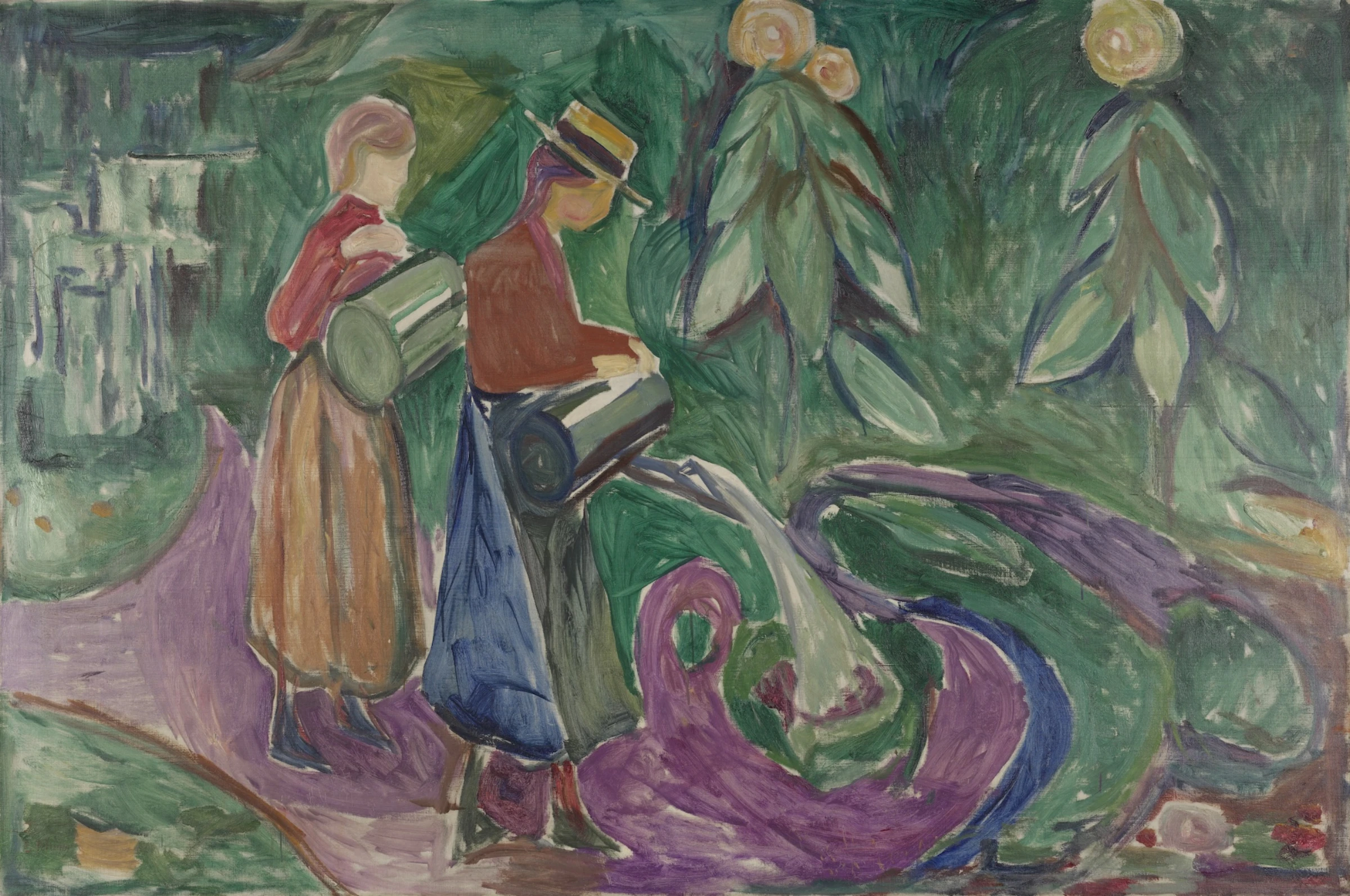
One of the most consequential Munch stories this season is not about rediscovery, attribution drama, or market movement. It is about context. The MUNCH museum in Oslo is presenting the Freia Frieze, a group of monumental paintings made for a chocolate factory canteen and rarely accessible as a museum body of work. For the first time, these paintings leave their long industrial setting and enter a focused institutional frame with preparatory material and historical interpretation.
The commission’s original site conditions are central to the exhibition’s significance. Ordered in 1922 by Freia director Johan Throne Holst for workers’ dining spaces, the paintings were installed within an environment defined by labor rhythms, dust, smoke, and changing workplace standards over decades. That history complicates the simplistic distinction between elite art and everyday industrial life. The Frieze was always public in one sense, but public within a controlled corporate ecosystem. The current exhibition relocates it into a civic museum space where broader audiences can evaluate both the paintings and the labor system that housed them.
Curator Ana María Bresciani frames the project around intersections of art, industry, and gender in interwar Norway. That framework is productive because it repositions the Frieze away from a purely decorative narrative. The paintings depict work and leisure scenes with an apparent calm, yet they were commissioned at a time when labor organization, social welfare, and industrial paternalism were all under renegotiation. Munch’s fast, open handling of form also sits interestingly against the commission’s practical function: images built for repeated daily exposure rather than singular contemplative encounter.
For museum professionals, the show is a reminder that twentieth-century “public” commissions often lived inside private infrastructures that shaped who could see them and under what terms. By bringing the Frieze into the museum, MUNCH is not only expanding access, it is recoding provenance as a social history. That move aligns with broader institutional shifts in Europe, where curatorial departments are integrating labor histories, production ecologies, and audience conditions into canonical artist narratives.
The exhibition also exposes a familiar conservation challenge. Works that remain in active non-museum environments can accumulate material damage while preserving a kind of site truth. Transfer to museum conditions improves preservation and scholarship but risks flattening that lived context. MUNCH’s decision to show preparatory sketches and foreground factory history is a smart response, keeping the industrial frame visible rather than treating the murals as isolated trophies of national modernism.
“Edvard Munch and the Chocolate Factory” runs from May 21 through October 11, 2026, and its relevance extends well beyond Oslo. It offers a practical model for institutions dealing with artist commissions embedded in corporate, civic, or infrastructural settings. Instead of asking whether such works belong to art history or social history, the show demonstrates that the category split is the wrong question. The stronger question is how museums can stage both histories together with enough rigor to change how audiences read the work.
The timing of the project is also strategic for the museum’s broader program. As institutions compete for attention in a high-volume exhibition economy, canonical artists are often presented through spectacle or immersive repackaging. This exhibition instead leverages archival and social specificity, and that may prove more durable with serious audiences. By centering the Freia commission, MUNCH reinforces an argument that major modern artists can still produce new scholarship when institutions investigate use-context, labor context, and circulation context together rather than repeating biography-led narratives.
Collectors and curators should pay attention to what this implies for future loan and partnership structures. Corporate-held or site-bound commissions across Europe remain understudied relative to market-facing works. If museums can develop credible frameworks for temporary transfer, contextual interpretation, and conservation planning, a much larger body of twentieth-century material could become publicly legible. The Freia Frieze presentation functions as proof of concept. It shows that moving a work from semi-private industrial life into museum discourse can widen understanding without erasing origin, provided the institution treats context as content, not backdrop.
The corporate side of the commission remains relevant to interpretation. Freia’s industrial history and brand identity shaped the original canteen context, while MUNCH now reframes the works for public scholarship and conservation. Background on the company is available via Freia, and Munch’s broader holdings can be explored through MUNCH Collection.