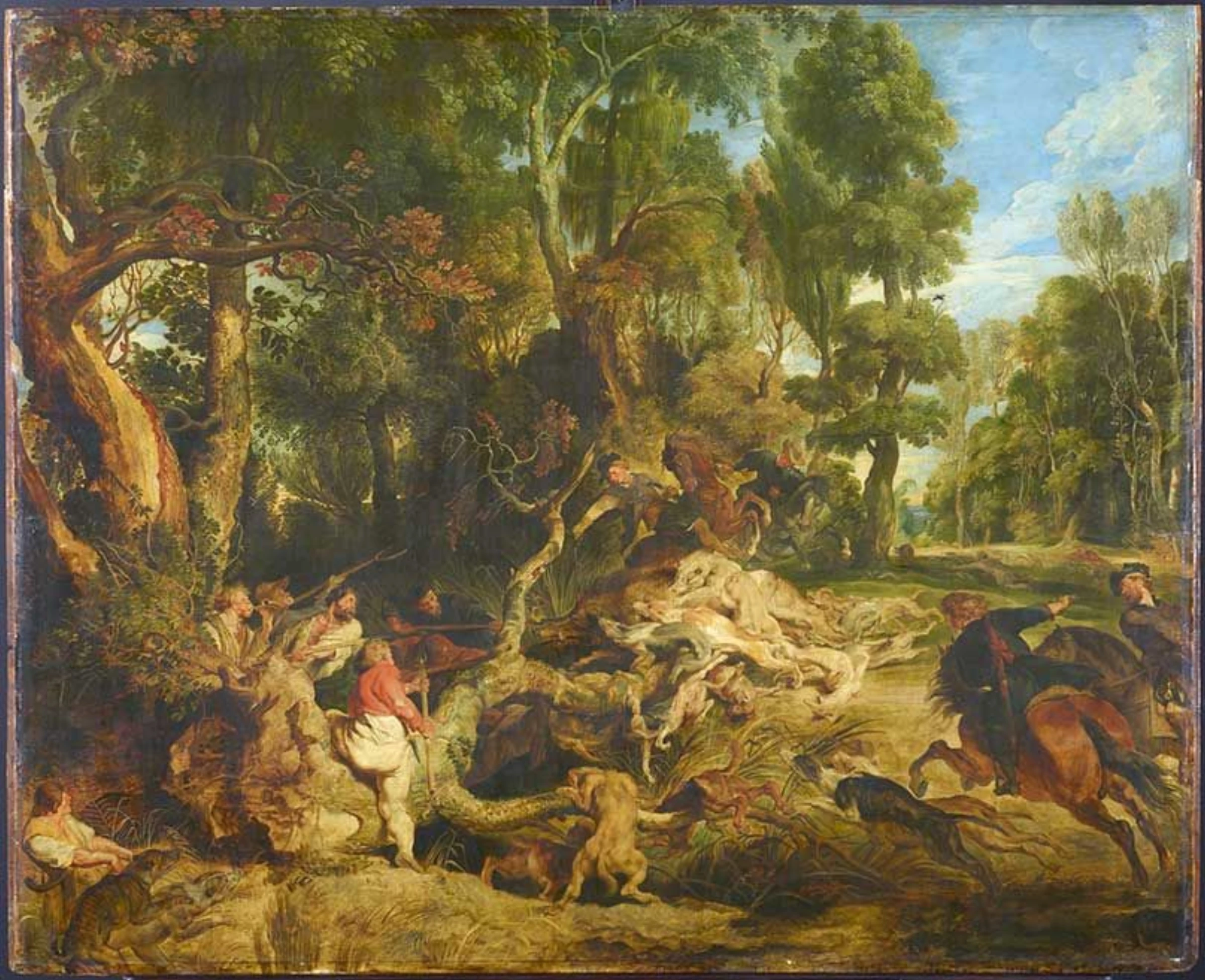
Dresden Wins TEFAF Restoration Funding for Rubens’s ‘The Boar Hunt’
A major Rubens panel in Dresden receives restoration support ahead of the 2027 anniversary exhibition, with conservation focused on varnish removal and panel stability.
Dresden’s Gemäldegalerie Alte Meister has received this year’s TEFAF Museum Restoration Fund award for conservation of Peter Paul Rubens’s The Boar Hunt (1616-18), according to reporting by The Art Newspaper. On paper, it is a funding announcement. In practice, it is a strategic move in how Old Master institutions rebuild public understanding of canonical works through conservation research rather than exhibition rhetoric alone.
The painting’s provenance is unusually strong and politically layered. Rubens reportedly painted the work for himself before it entered major elite collections and eventually Dresden’s holdings in the eighteenth century. It later endured wartime displacement, including a postwar period in Moscow storage, before returning to Dresden in the mid-twentieth century. Works with this biography are not neutral objects. They are records of ownership systems, state power, and the fragility of cultural continuity.
The current conservation challenge is technical but consequential for interpretation. A discolored nineteenth-century varnish layer has muted the composition’s velocity and color relationships, while earlier structural interventions to the panel introduced vulnerabilities over time. Cleaning and stabilization are not cosmetic upgrades. They alter what scholars, curators, and audiences can actually see, which in turn reshapes arguments about workshop participation, painterly sequence, and material intent.
Conservators are reportedly using solvent cleaning and examination protocols developed through a multi-year research collaboration involving Dresden, Antwerp institutions, and academic partners. That cross-institutional model is increasingly important for high-risk Old Master treatments: fewer single-museum decisions, more documented peer process, and stronger reproducibility of findings. Restoration funding is therefore not only about saving one object. It is about financing method.
The museum plans to present the restored panel in a 2027-28 Rubens exhibition timed to the artist’s 450th anniversary. Anniversary programming can drift into brand management when it leans on familiar masterpieces without new scholarship. This project points in a better direction, because the treatment itself becomes part of the exhibition’s knowledge proposition. Visitors should be able to track what changed, why it changed, and what remains uncertain.
For museum leaders, the announcement also highlights a practical reality: conservation now competes for attention and resources in a climate where spectacular acquisitions dominate headlines. External funds such as TEFAF’s can offset that imbalance, but only if institutions communicate conservation outcomes in public language rather than lab jargon. Before-and-after images are not enough. Audiences need to understand what intervention preserves, what it cannot recover, and where historical damage is irreversible.
There is a market implication as well. Major conservation projects on canonical works influence attribution debates, catalogue raisonné priorities, and collector confidence in adjacent material. As technical imaging and treatment reports circulate, they shape valuation environments far beyond one museum wall. Restoration today is part of the scholarly economy and part of the market information economy, simultaneously.
The Dresden project should be read as a model for 2026 institutions navigating constrained budgets and elevated expectations: pick a work with high historical signal, fund serious treatment, publish the research path, and integrate the results into curatorial programming. That approach creates durable cultural value, not just temporary traffic.
Institutional context: TEFAF Museum Restoration Fund, Gemäldegalerie Alte Meister, Royal Museum of Fine Arts Antwerp.