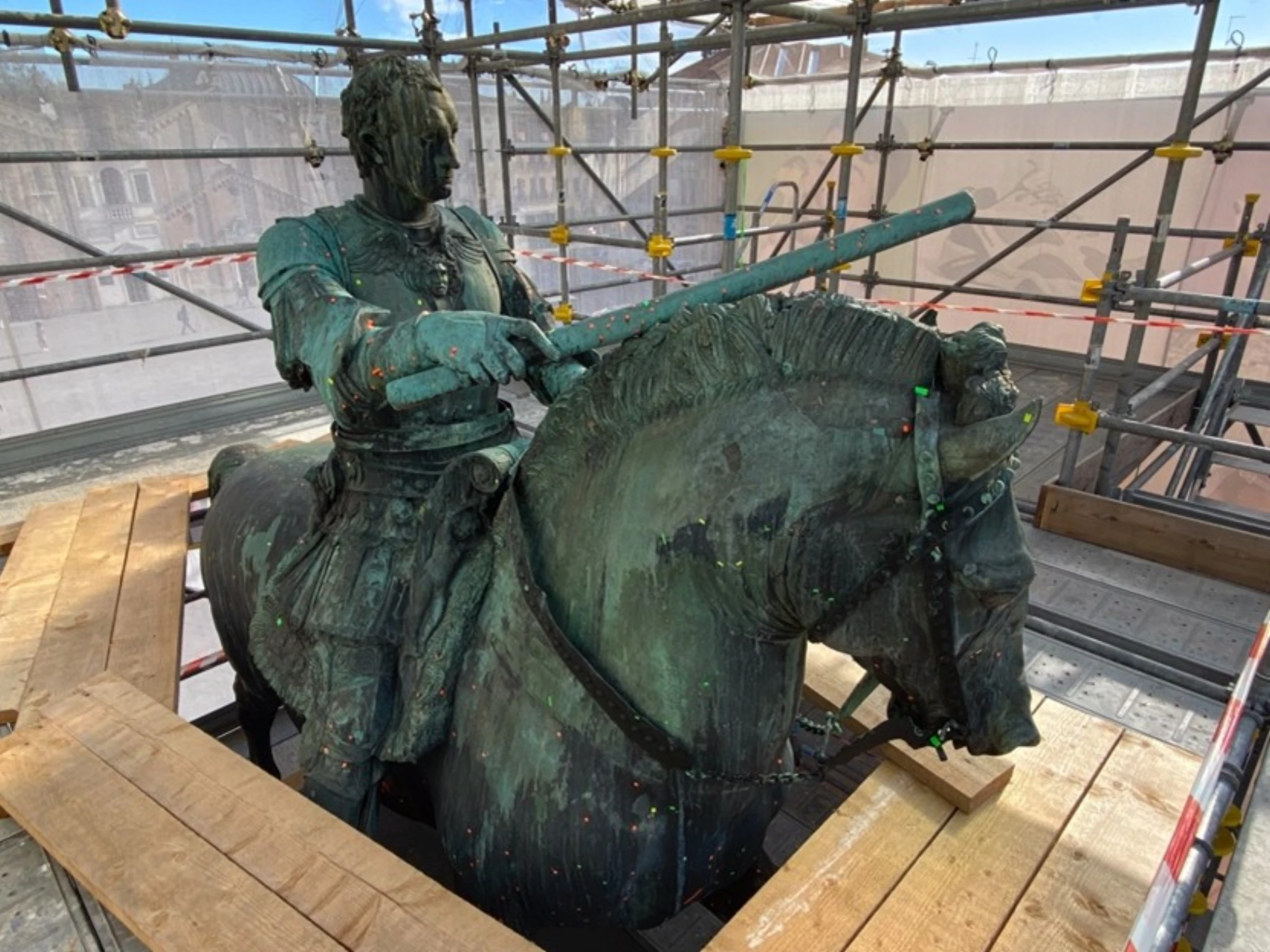
Donatello’s Gattamelata Leaves the Piazza as Padua Weighs a Permanent Indoor Future
Padua’s landmark Donatello equestrian bronze is undergoing a major restoration, forcing a decision about whether one of the Renaissance’s defining public monuments can safely remain outdoors.
One of the most consequential conservation questions in Europe is now centered on a single bronze rider in Padua. Donatello’s Gattamelata, completed in 1453 and installed outside the Basilica of Saint Anthony, has been removed from its pedestal for extensive study and treatment. The move is not symbolic. It reflects real structural and chemical risk in a work that has endured weather, pollution, war-era displacement, and decades of stress in an exposed urban setting.
The monument sits beside the Pontifical Basilica of Saint Anthony, and it has long functioned as both sculpture and civic marker. For curators, conservators, and lenders, what happens next is the real story: whether an original work this vulnerable can still fulfill a public role outdoors, or whether long-term stewardship now requires museum conditions and a replica in the square.
The current campaign is being supported by Save Venice and Friends of Florence, each contributing substantial funding to diagnostics, treatment, and stabilization. The project team has moved beyond surface cleaning logic. They are evaluating interior conditions, historic joins, stress points, and the interaction between the bronze and its stone base. That deeper technical approach is why this case matters well beyond Padua.
For collectors and institutions, the lesson is immediate: conservation risk compounds quietly until a work reaches a threshold where public display terms must be renegotiated. In this case, analysis has included endoscopic inspection, digital mapping, and structural review of both rider and horse. The horse and rider were separated in a highly controlled operation, underscoring how complex intervention becomes once deterioration has advanced and the object’s engineering is itself part of the heritage value.
There is also a governance dimension. The final decision involves custodians at the basilica and state heritage oversight, not a single director’s preference. That matters because any outcome, return outdoors or move indoors, creates a precedent for similarly exposed bronzes in historic centers. Once a major sculpture of this rank is relocated permanently, other sites will be pressed to justify why their own vulnerable originals remain outside.
Padua is not the first city to face this dilemma. Florence’s original David moved indoors long ago, and Rome’s Marcus Aurelius has been protected in museum conditions for decades. What is different here is the timing and transparency: the project unfolds in a period when public audiences understand climate pressure, maintenance budgets, and risk management in far more concrete terms. The old fiction that monumentality equals permanence has become harder to sustain.
The financial side is equally important. Repeated outdoor treatment can become a recurring operational burden with no guaranteed stability, especially when traffic vibration, moisture cycles, and biological deposits continue to act on the surface and joins. Museums, foundations, and municipalities increasingly face a portfolio problem: whether to preserve authenticity in situ at higher recurring cost, or preserve material integrity in controlled environments with a changed public experience.
For the art world, this is not merely a conservation story. It is a policy story about what we mean by public access in the twenty-first century. Is access seeing the original exactly where history placed it, regardless of risk, or is access sustained visibility over centuries, even if that requires mediation through replicas and interpretation?
The coming decision in Padua will therefore reverberate through boards, collections committees, and heritage agencies far beyond Italy. If the original returns to the piazza, it signals a willingness to fund continuous intervention as the price of authenticity. If it stays indoors, it affirms a different doctrine, that stewardship can require separating historical location from historical material. Either way, Donatello’s rider has become a test case for how institutions plan the future of outdoor masterpieces under modern conservation realities.