Donatello’s Gattamelata Enters Restoration and Reopens an Old Question: Should Originals Stay Outside?
As Donatello’s Gattamelata undergoes a major restoration in Padua, conservators and custodians are confronting a question that reaches beyond one monument: whether a masterpiece can remain outdoors without being slowly sacrificed to exposure.
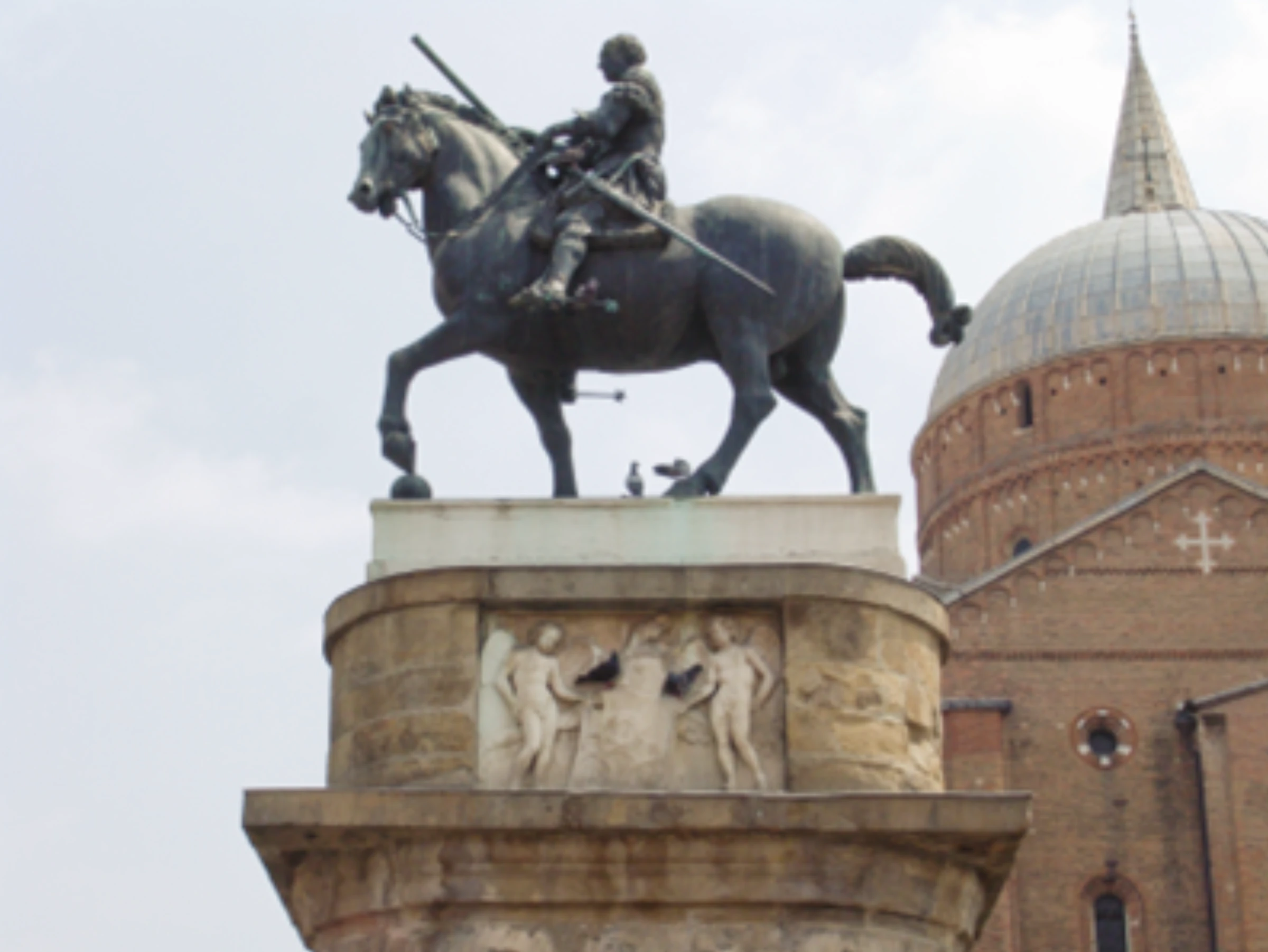
Donatello’s Equestrian Monument to Gattamelata has been moved indoors in Padua for a major restoration, and the work may never return to the piazza that defined it for centuries. The Art Newspaper reports that the bronze, one of the foundational equestrian monuments of the Renaissance, is now at the center of a practical and philosophical dispute: once an outdoor masterpiece has demonstrably begun to fail under exposure, what exactly is being preserved by sending it back outside?
The facts are serious enough on their own. The monument, completed around 1453 and assembled from 36 cast bronze sections, has been showing corrosion associated with so-called bronze cancer. Its stone base has also deteriorated through weather, vibration, and the consequences of earlier interventions. The restoration is backed by Save Venice and Friends of Florence, whose project page frames the campaign as an urgent effort involving not only the horse and rider but the base and original reliefs as well. What is under review, then, is not cosmetic cleaning but the long-term survival strategy for a monument central to the history of bronze sculpture.
That strategy now depends on a hard choice. The scientific and conservation work can stabilize the sculpture, but its final treatment will vary depending on whether the original remains outdoors or enters a museum setting. The difference is not marginal. Keep the original in the square and conservators face recurring cycles of intervention every few years. Move it indoors and the public loses the charged historical experience of encountering Donatello’s bronze in relation to the Basilica of Saint Anthony and the urban space it was made to command. Either option preserves something, and either option gives something up.
This is why Gattamelata is larger than a single restoration story. It belongs to a long lineage of monuments whose meaning is partly inseparable from site. Donatello conceived the work in dialogue with antique precedent, especially the Marcus Aurelius equestrian statue in Rome, but he also built a distinctly civic image of military authority for Padua. To remove the original from that setting is not a neutral technical action. It changes the work’s public ontology. Yet the counterargument is just as compelling. If fidelity to site guarantees steady material loss, then site-specific authenticity becomes a romantic pretext for avoidable damage.
Conservation practice has already answered this question in many cases. Florence long ago accepted a copy of Michelangelo’s David in Piazza della Signoria while the original remained protected indoors. Rome moved Marcus Aurelius into the Capitoline Museums. Gattamelata has simply arrived at the same threshold later than most, in part because bronze in open air has a heroic aura that still seduces custodians and the public alike. The restoration now forces Padua to decide whether that aura is worth the maintenance burden and the physical risk.
There is also a governance story here. The decision will not be made by one curator alone but through a network of actors, custodians of the Basilica, heritage authorities, scientific advisors, and donor organizations. That matters because conservation funding increasingly shapes display outcomes. Philanthropic intervention can rescue works that public budgets struggle to maintain, but it also sharpens the pressure for pragmatic solutions. Donors underwriting a seven-figure restoration are not funding sentiment. They are funding durability.
For museums and public-art authorities elsewhere, Gattamelata offers a timely lesson. The debate is often framed as original versus copy, as if the copy were automatically a compromise. In reality, a well-made replica can preserve a monument’s urban function while allowing the original to be studied, interpreted, and maintained under stable conditions. The real failure is not copying. It is pretending that environmental exposure is culturally neutral when conservators already know the price.
Whatever Padua ultimately decides, the restoration has already shifted the conversation. Gattamelata is no longer merely a monument in need of treatment. It is now a case study in how heritage institutions measure public meaning against material survival. That is a decision every city with outdoor masterpieces will have to make more often, and with less room for nostalgia.