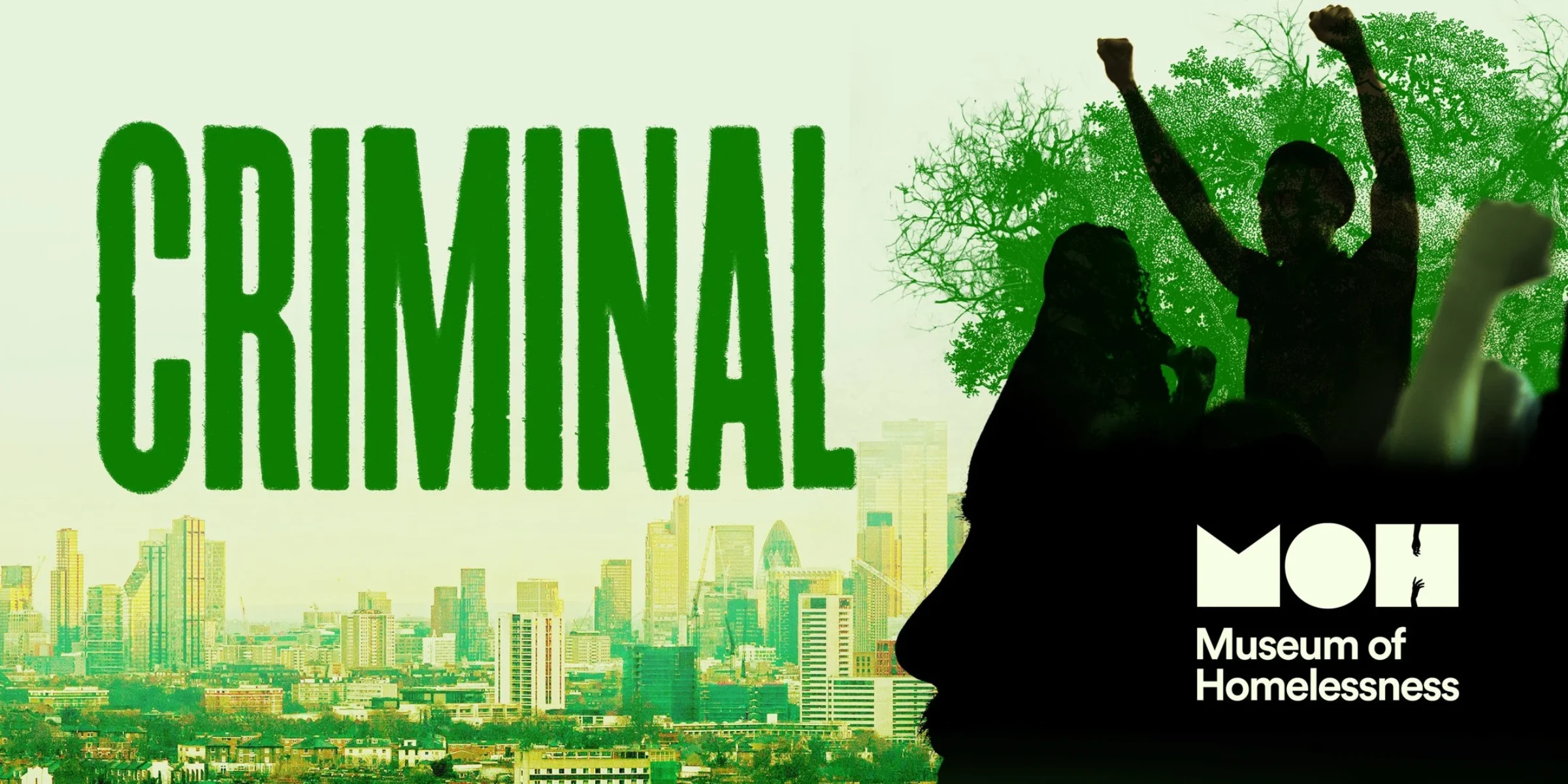
London Show Tracks the Criminalisation of Homelessness
A new Museum of Homelessness exhibition in London links present-day housing precarity to enclosure, colonial expansion and the long policing of unhoused people
Museum of Homelessness Turns Historical Research Into a Political Exhibition
One of the sharpest shows opening in London this week is not arriving from a blue-chip museum or an art-fair satellite. It is coming from the Museum of Homelessness, where Criminal: The Untold History of Homelessness argues that the policing of unhoused people did not begin with the Victorian state and did not end with it either. Drawing on research summarised in The Art Newspaper, the exhibition rewinds the timeline to the early seventeenth century, a period the museum describes as a "Homelessness Big Bang" in which enclosure, economic transformation and colonial expansion reorganised who could occupy land, who could move freely and who would be punished for lacking property.
That framing does more than provide historical depth. It refuses the comforting fiction that homelessness is a modern policy malfunction awaiting a managerial fix. By placing the story inside long histories of land seizure, labour control and imperial extraction, the exhibition insists that homelessness has been actively produced. The distinction matters. If homelessness is made, then it can be unmade, and cultural institutions cannot treat it as a tragic backdrop while leaving the machinery of criminalisation unnamed.
The Exhibition Uses Artists and Activists to Undo Sanitised Narratives
The show is staged in an English perennial meadow at the museum's Finsbury Park site, which already tells you something about its method. This is not an antiseptic white-cube survey in which social crisis is aestheticised from a safe distance. It is an exhibition grounded in site, ecology and the contested meanings of common land. Artists and activists including 10 Foot, Matt Bonner and Gemma Lees appear not as decorative contributors to an institutional thesis but as participants in a larger argument about property, punishment and public memory.
10 Foot's new sculpture Fairie Newbuild, made from palisade fencing and planted with a hawthorn tree, is the key object in that argument. According to the museum's account, the work connects today's hard-edged defensive architecture to older forms of enclosure and displacement. The hawthorn, dense with folklore and boundary symbolism, serves as a counter-image to the fencing that now organises urban exclusion. It is easy to imagine a weaker exhibition using such symbolism as poetic fog. Here it seems aimed at something more direct: showing that the technologies of exclusion may change shape, but they keep reproducing the same message about who belongs and who can be removed.
The exhibition gains force because it treats research, art and organising as mutually reinforcing rather than as separate departments. The museum's own work since 2015 has already made it one of the few British institutions willing to build a collection around homelessness without flattening lived experience into charitable sentiment. In that sense, Criminal belongs to a larger institutional practice, one that art audiences should understand alongside other recent museum power stories, including our coverage of the backlash over Adam Budak's dismissal from MOCAK. Both cases ask what happens when institutions stop pretending neutrality and become sites where political conflict is visible.
Why the Historical Frame Matters Right Now
Museum director Matt Turtle has tied the exhibition explicitly to the current political climate, warning that rising far-right movements are arriving alongside increasing homelessness and increasingly toxic rhetoric about unhoused people. That is not opportunistic framing. It is the present tense of the show. Across Britain and beyond, housing insecurity is often narrated through suspicion, disgust and false claims about fraud, danger or dependency. By historicising those scripts, the exhibition argues that they are not spontaneous reactions to urban distress. They are old political tools, repurposed whenever states and publics need a morally convenient explanation for visible inequality.
The repeal of the Vagrancy Act has encouraged a round of self-congratulation in Britain, as if ending one notorious statute settles the matter. It does not. Laws change more quickly than institutional reflexes. Police powers, hostile architecture, welfare conditionality and planning choices can all reproduce punishment without relying on the most obvious nineteenth-century language. That is why the exhibition's deeper periodisation matters. It tells viewers that criminalisation is not a single law to be removed from the books but a durable habit embedded in how land, movement and social worth are organised.
Gemma Lees's work on the linked histories of people transported from England, Ireland and Africa strengthens that argument by refusing to separate domestic poverty from colonial violence. Much official storytelling about homelessness still isolates the issue inside national social policy, as if imperial expansion happened over there while displacement happened here. The exhibition collapses that convenience. It suggests that the management of unwanted populations at home and abroad developed through related logics of extraction and control, a point cultural institutions have often been slow to make with real clarity.
There is a formal lesson here too. Socially engaged exhibitions often fail because they overload the wall text and underthink the visual stakes, leaving viewers with an ethics seminar thinly disguised as an art show. Criminal appears to avoid that trap by grounding the thesis in memorable forms: fencing, meadow, hawthorn, transport, testimony. Those choices do not merely illustrate an argument; they make the argument spatial. For a museum operating without the resources of a national institution, that kind of curatorial economy is impressive and worth studying.
What Serious Socially Engaged Art Looks Like When It Stops Seeking Approval
Too much institutional art about inequality arrives padded with caution. It names a crisis, commissions sympathetic work and stops short of identifying the structures producing that crisis. The Museum of Homelessness is taking the opposite route. The exhibition is openly partisan in the best sense: it has a thesis, names enemies, shows evidence and asks audiences to understand homelessness politically rather than sentimentally. That stance is inseparable from the institution's own history. Founded in 2015 by Matt and Jessica Turtle and shaped by lived experience of homelessness, the museum has built authority not through scale but through credibility and refusal.
That refusal extends to who gets invited into the frame. 10 Foot is not the sort of artist every museum would embrace without hedging, given both his notoriety and his own history of incarceration. Here those facts are not liabilities to be softened for funders. They are part of the exhibition's intelligence. The show understands that criminalisation is not an abstract theme but an administrative force with afterlives in housing, mobility and social stigma. When 10 Foot connects enclosure of land to enclosure of minds, he risks sounding grandiose on paper. Inside the exhibition's logic, the statement lands as diagnosis.
What Comes Next for the Institution and for the Debate
Criminal runs through 25 July, but its real test is whether it can travel beyond the usual art audience and alter how other institutions speak about homelessness. The museum is now building a national collection on homelessness, and that project could become one of the most consequential acts of collection-building in British culture if it continues to tie objects to policy histories rather than to a softened heritage narrative. London does not need another compassionate exhibition that leaves power untouched. It needs institutions willing to say that housing injustice is designed, defended and culturally rationalised.
That is why this exhibition matters beyond its modest scale. It demonstrates that a small institution with a precise political imagination can outperform much larger museums in both rigor and urgency. While bigger organisations continue to debate how far they can go without upsetting donors or trustees, the Museum of Homelessness is showing what it looks like to use exhibition-making as historical correction and present-day intervention at once. The result is not merely moving. It is bracing, and London could use more of that.
Visitors who want to understand the show on its own terms should take the institution seriously as more than a temporary venue. The museum's main site makes clear that it sees collection-building, advocacy and public programming as one continuum. That is a harder model than the art world's usual cycle of issue-based programming, because it demands follow-through after the opening week. If Criminal succeeds, it will be because the exhibition convinces audiences that homelessness is not an unfortunate social theme for culture to acknowledge, but a political history culture has helped obscure for far too long.
That challenge now extends outward. Other museums can no longer claim they lack a model for talking about housing, punishment and public space with historical seriousness. A small institution in Finsbury Park has done the work and done it without euphemism. The question is whether larger organisations will meet that standard or continue to outsource the hardest social histories to underfunded specialists. If they choose the latter, Criminal will stand not just as a strong exhibition but as an indictment of the wider museum field's caution.
That would be a deserved provocation. Cultural institutions love to speak about inclusion in broad and sentimental language, yet many remain uneasy when inclusion requires them to confront property, policing and state violence directly. Criminal does not offer that escape route. It asks viewers to see homelessness as a history still being administered in the present, and it asks the museum sector to decide whether it will merely host that truth at the margins or let it reshape the centre of its own thinking.