Counterpublic Names 47 Artists for 2026 Triennial, Betting on Site-Specific Civic Friction
St. Louis’s Counterpublic announced a 47-artist lineup for its third triennial, with commissions focused on migration, technology, and climate along the Mississippi riverfront.
Counterpublic has released the artist list for its third triennial in St. Louis, scheduled for September 12 through December 12, 2026, with forty-seven participating artists and collectives and nearly fifty commissions. The edition is titled Coyote Time, borrowing the gaming term for the split-second in which a player has technically left stable ground but can still choose a direction. As framing devices go, it is unusually precise for this moment: institutions, artists, and cities are all operating in delayed-impact conditions where decisions made now are felt later.
The curatorial team, Jordan Carter, Raphael Fonseca, Stefanie Hessler, Nora N. Khan, and Wanda Nanibush, positions the exhibition around climate, technology, education, migration, and civic structure. This is familiar language in biennial circuits, but Counterpublic’s operational model has always been to route those themes through specific urban sites rather than neutral white-cube abstraction. The 2026 plan continues that strategy with commissions on both sides of the Mississippi and programming tied to the city’s social geography.
The lineup combines internationally established names, including Rebecca Belmore, Carolina Caycedo, Glenn Ligon, Rirkrit Tiravanija, and Ryan Trecartin with Lizzie Fitch, with St. Louis-based artists and collectives such as Occupy Vacancy and People’s Art and Recreation Center. That mix matters because triennials often struggle between two pressures, importing attention and building local consequence. Counterpublic appears to be pursuing both at once, a higher-risk path that can produce stronger exhibitions if the organizational scaffolding holds.
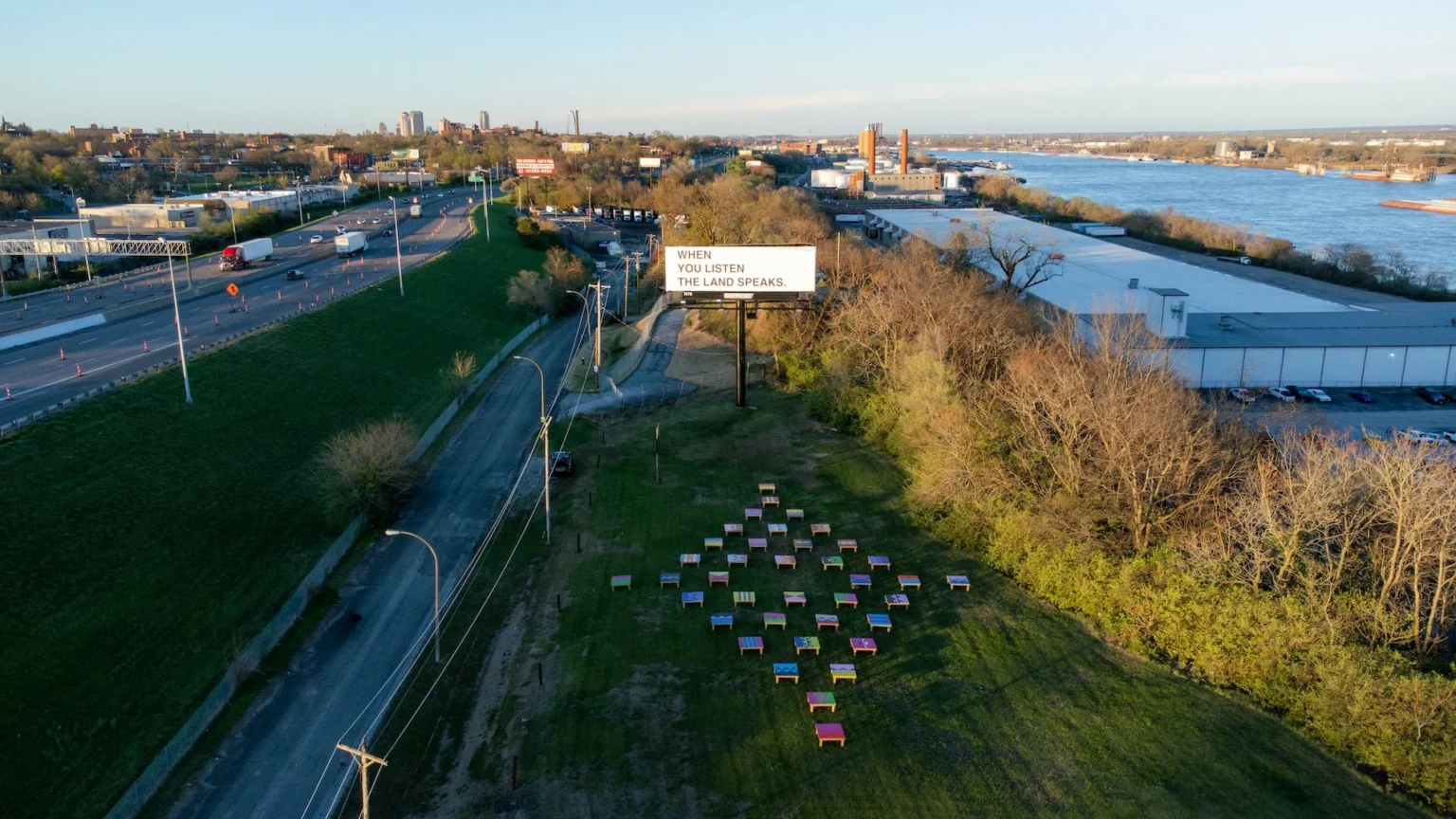
One of the most consequential structural details is the commitment to site-responsive works along the riverfront near the Gateway Arch. Public-facing commissions in high-traffic civic zones are expensive, logistically complex, and politically exposed. They also carry a different burden of legibility than museum installations, because audiences include passersby with no curatorial primer. If these commissions succeed, the triennial can meaningfully shift how contemporary art functions in St. Louis’s public realm.
The title commission by Alice Bucknell, connected to the city’s City Museum, is a smart thematic anchor because it translates social risk into a familiar interaction model. You move, you misstep, you recover, you choose again. That language is legible to younger audiences without flattening the political stakes. Curators elsewhere should pay attention to this kind of framing, where contemporary art discourse is translated without being diluted.
Counterpublic leadership has described this edition as diasporic in scope and rooted in St. Louis at a time of renewed border politics. That claim will be tested in production choices: who gets long-term support, who is asked to represent a theme in one-off fashion, and how local institutions continue the work after the closing date. The most credible triennials now are judged less by opening-week optics than by what remains six months later.
For collectors and curators watching from outside Missouri, Counterpublic 2026 is an important barometer for US regional exhibition infrastructure. Major coastal museums are not the only places where institutional form is being reworked. In some cases, regional formats can move faster, take larger civic risks, and produce sharper experiments in how art intersects with public life. Coyote Time looks designed to test exactly that possibility.