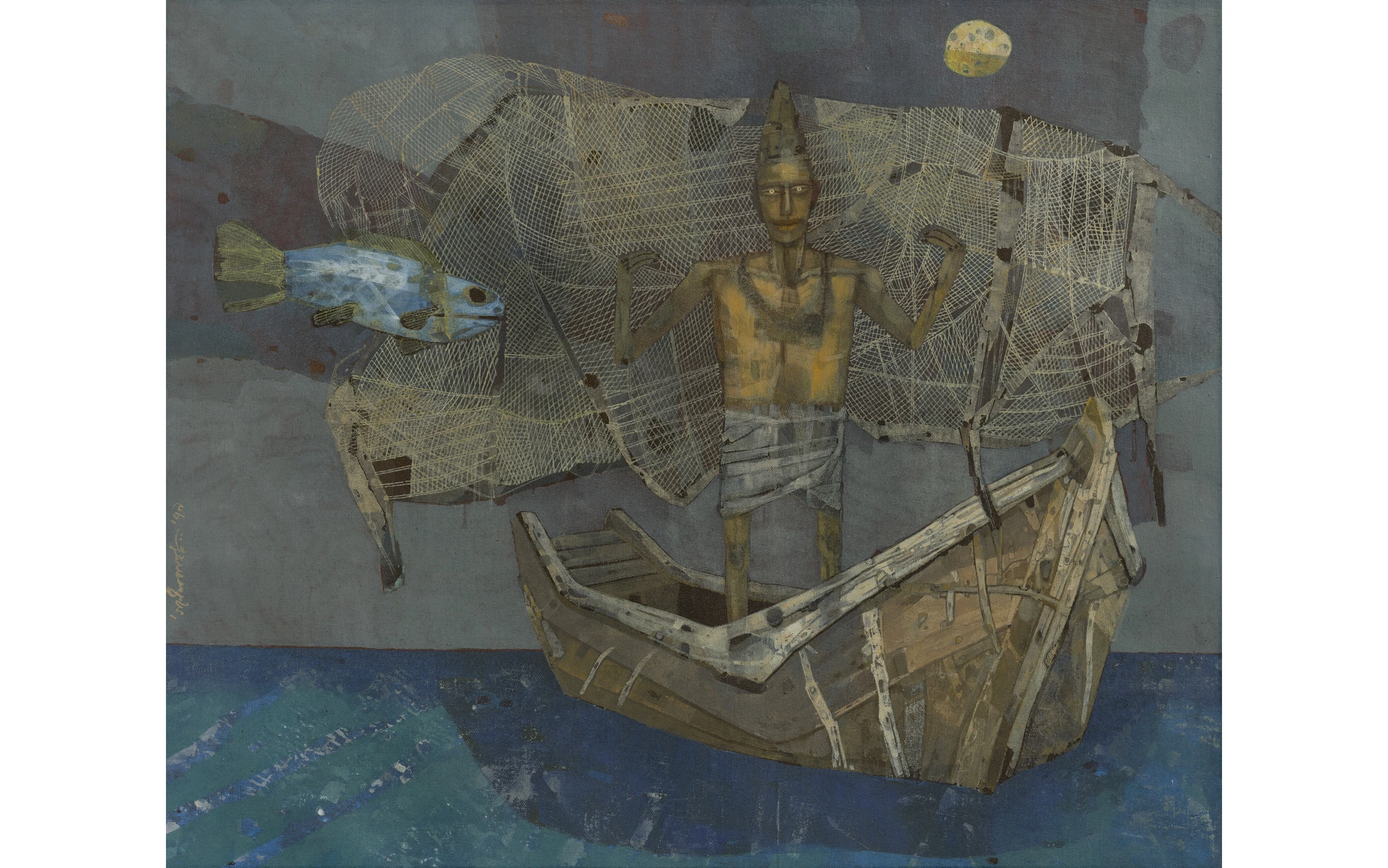
Christie’s Returns South Asian Modern Sales to London as Category Competition Intensifies
Christie’s will stage its first London South Asian Modern and contemporary sale in seven years, signaling stronger confidence in category depth and sharper rivalry across auction houses.
Christie’s decision to bring a dedicated South Asian Modern and contemporary sale back to London this June is a market signal, not a scheduling footnote. The house is effectively betting that collector demand in this category now has enough depth, scholarship, and pricing confidence to support an additional high-visibility venue outside the standard New York rhythm. In a global market that remains selective and risk-aware, that is a meaningful institutional commitment.
The sale, framed around a single-owner group, arrives after two years of stronger headline totals for South Asian categories and a noticeable expansion in buyer sophistication. Specialists increasingly describe collecting in this sector as less speculative than in prior boom cycles. More bidders are now working through provenance, exhibition history, and art-historical placement instead of simply chasing scarcity and momentum. That shift tends to produce steadier long-run pricing, and it rewards houses able to secure concentrated, high-quality consignments.
London is a strategic location for this push. It combines auction infrastructure, legal familiarity for international sellers, and seasonal access to South Asian diaspora collectors who spend extended periods in the UK. It also sits in active dialogue with institutions that have widened exhibition platforms for South Asian artists, including the Royal Academy of Arts, Serpentine, and V&A. That institutional context matters because auction categories gain resilience when curatorial attention broadens beyond market cycles.
Competition is the other clear factor. Sotheby’s and regional players have pushed aggressively in South Asian segments, posting robust totals and, in some cases, stronger record-setting velocity for artists outside the most established canon. Christie’s London return can be read as both confidence play and defensive positioning. If houses want leadership in this category, they need to win on consignments, scholarship, and buyer trust simultaneously.
The composition of the June offering, with pronounced Bengal and Santiniketan-linked depth, also points to where the next stage of category maturation may happen. Rather than relying only on a narrow group of ultra-liquid names, auctions are testing whether historically important but less globally overexposed artists can command sustained international demand. If those works perform, the category’s center of gravity broadens. If they struggle, houses may revert to conservative concentration around a few already dominant artists.
For collectors and advisors, the implication is straightforward. South Asian Modern art is now operating in a more institutionalized market environment, where diligence and connoisseurship create advantage. The era of easy arbitrage off under-recognized names is narrowing as documentation improves and competition rises. Buyers who still treat this segment as a short-cycle trade are likely to be outperformed by those building coherent, research-grounded positions over multiple seasons.
For institutions, this moment is an opportunity. Auction visibility can drive resources and public attention, but museums and archives still determine which artists become structurally legible to broader art history. As houses increase category investment, curatorial infrastructures should do the same. The strongest markets are built when scholarship and sales reinforce each other rather than pull in opposite directions.