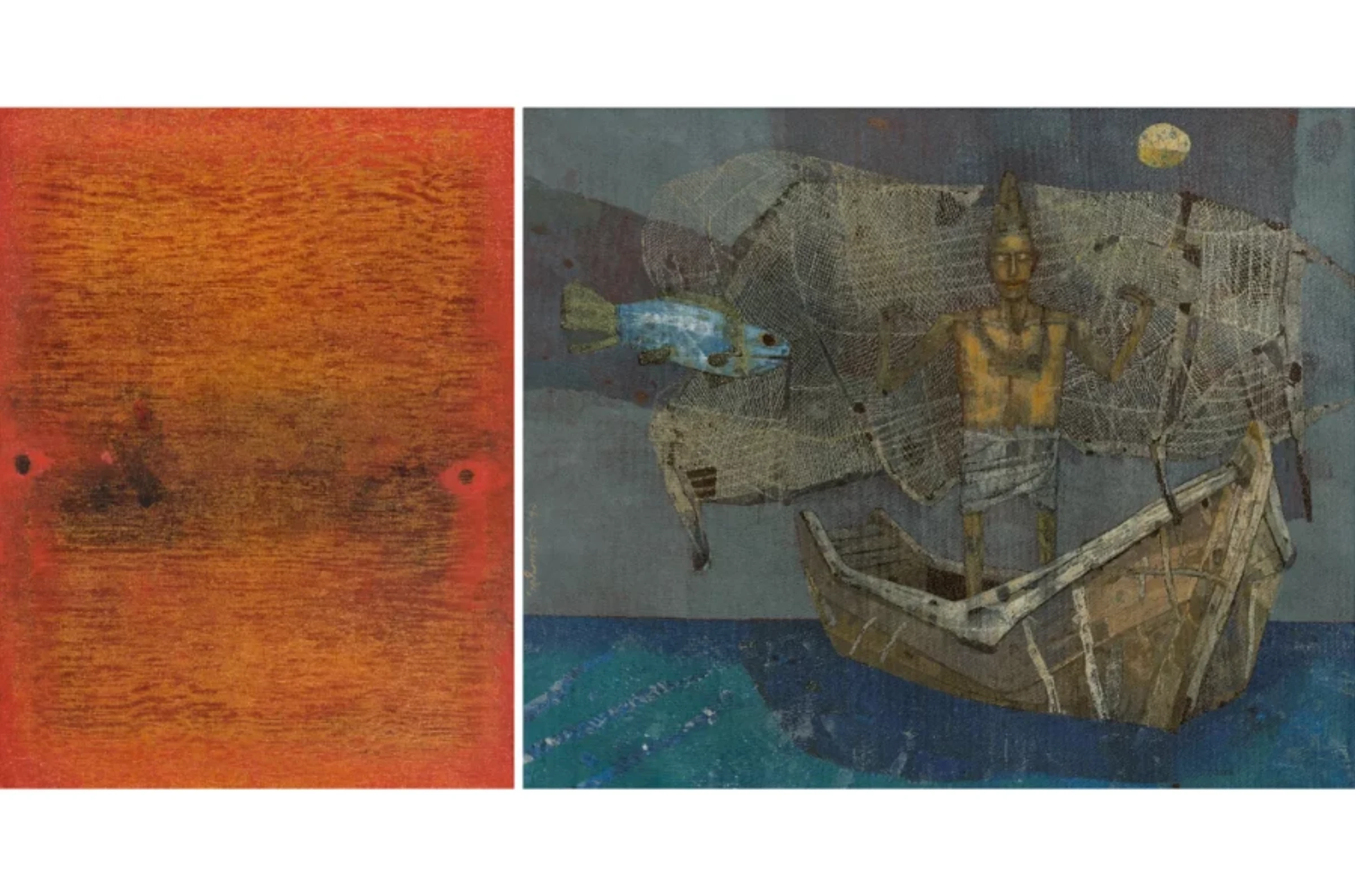
Christie’s Returns South Asian Modern Sale to London After Seven-Year Gap
Christie’s will stage its first dedicated London sale of South Asian Modern and contemporary art since 2019, a move that reflects stronger demand, deeper scholarship, and intensifying competition in the category.
Christie’s decision to return a dedicated South Asian Modern and contemporary sale to London in June is more than a calendar update. It is a market signal about where power is consolidating, who is setting price narratives, and how quickly the category is moving from specialist segment to structurally global field. The sale, positioned around a 93-lot private collection with deep Bengal holdings, marks the house’s first London event of this kind since 2019.
The immediate backdrop is performance. Christie’s recent New York result in the category reached $27m, and houses across London, New York, and New Delhi are now competing for consignments that would have struggled for similar attention a decade ago. In category terms, the cycle looks mature enough to support both headline records and mid-estimate depth, which is what determines whether momentum is durable or merely speculative.
London’s role in that equation is strategic. The city still concentrates legal infrastructure, advisory networks, and cross-border capital that matter for high-value consignments. It also remains a seasonal meeting point for South Asian collectors operating transnationally. Christie’s is effectively betting that those conditions can support a focused sale outside its default New York cadence, while reinforcing the city’s status as a principal venue for category-defining material.
The collection profile also matters. A Bengal-leaning group that includes works tied to Santiniketan lineages places art-historical narrative at the centre of commercial positioning. This is not incidental. Auction houses increasingly frame South Asian works through institutional discourse rather than solely through rarity language, partly because museums and curators are now active participants in how value is legible to buyers. The presence of artists linked to these networks aligns with broader institutional interest across venues such as the Royal Academy, the Serpentine, and the V&A.
Competition is simultaneously tightening. Sotheby’s has pushed hard in the same category, including record-setting performances for artists previously underpriced in international rooms. Regional houses are also scaling globally, with firms such as Astaguru expanding London operations to stay closer to both buyers and consignors. The effect is a denser ecosystem where no single house controls narrative by default.
For collectors, the development changes due diligence priorities. Price history remains necessary, but it is no longer sufficient. Buyers are increasingly evaluating exhibition trajectories, catalogue scholarship, conservation quality, and provenance depth as integrated value drivers. In a category where historical underdocumentation has long affected confidence, credible research can move bids as much as estimate strategy.
For curators and institutions, the auction calendar is becoming a practical intelligence stream. Which artists are repeatedly being positioned as anchors, which geographies are receiving premium framing, and which periods are gaining new scholarship all offer clues about where institutional attention may need to accelerate to avoid following the market rather than shaping discourse.
The broader takeaway is that South Asian Modern is no longer a peripheral add-on to mainstream twentieth-century narratives. The London sale confirms that the category now operates within the same infrastructure of competition, branding, and institutional alignment that has long defined other blue-chip sectors. Whether June overperforms or lands conservatively, the strategic move has already done its work: Christie’s has declared London a live battleground again.