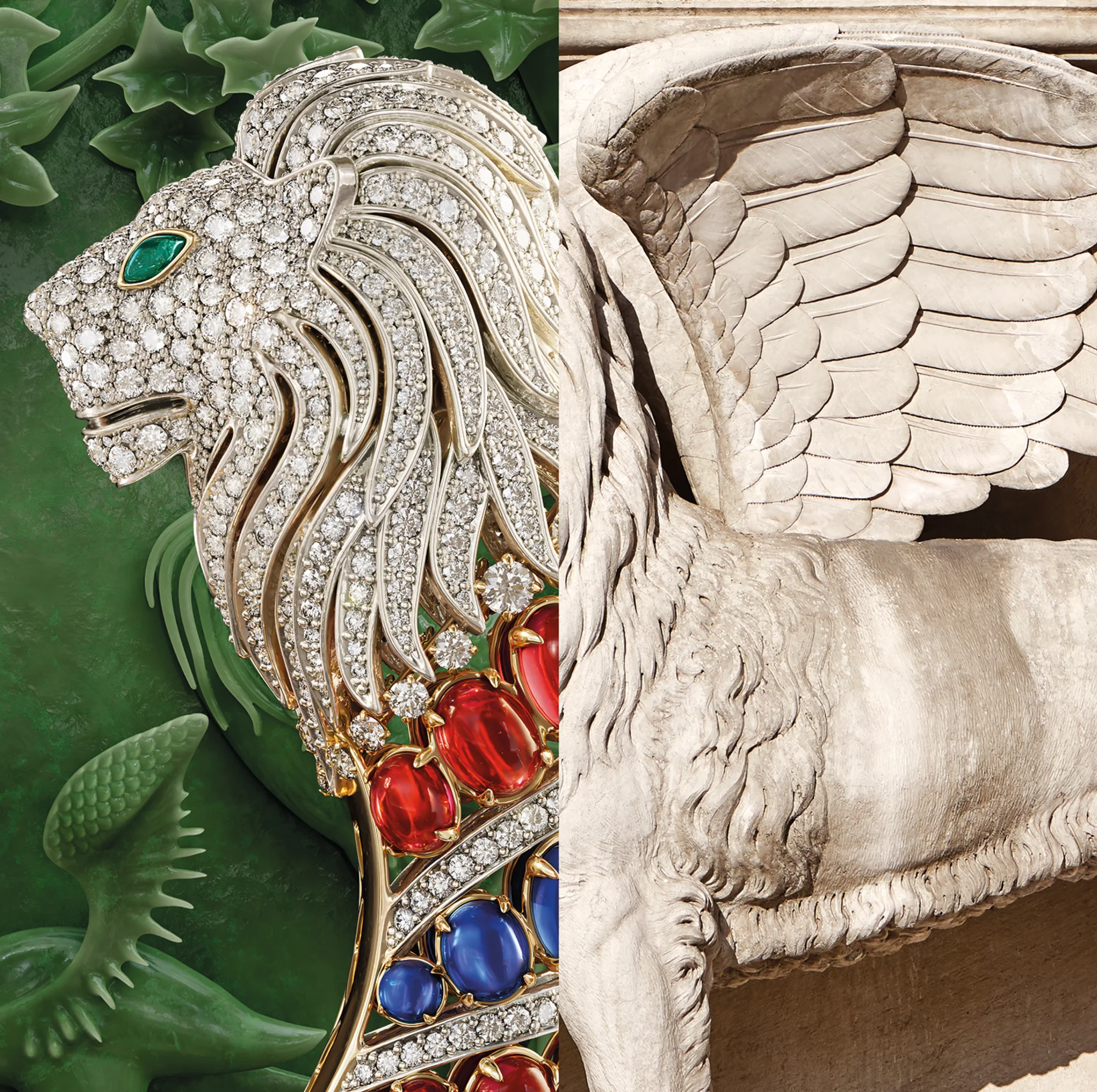
Bvlgari Opens Venice Biennale Partnership with Two Collateral Projects
At the 2026 Venice Biennale, Bvlgari begins its exclusive partnership run through 2030 with a Lotus L. Kang commission at the Giardini and a parallel Fondazione Bvlgari presentation at Biblioteca Marciana.
Bvlgari has launched its new role as exclusive partner of the International Art Exhibition of the Venice Biennale with a two-site program for the 2026 edition, beginning a partnership scheduled through 2030. The opening move combines a Lotus L. Kang installation at Spazio Esedra in the Giardini with a Fondazione Bvlgari presentation at Biblioteca Nazionale Marciana in Piazza San Marco.
The first project places Kang's materially unstable installation language into a branded collateral structure that still has to meet biennial-level curatorial scrutiny. Kang's work has consistently tested inheritance, translation, and impermanence through forms that remain in process rather than fixed display objects. Positioning that practice at the Giardini gives Bvlgari immediate visibility inside the exhibition's most symbolically charged geography.
The second project pairs Lara Favaretto and Monia Ben Hamouda at Marciana, where site-specific installations will be staged against the library's historic interiors. The pairing is strategic. Favaretto's long-running Momentary Monument framework and Ben Hamouda's recent recognition through the MAXXI Bvlgari Prize align the foundation's stated commitment to both established and emerging trajectories active in Italy.
What changes in 2026 is duration. Single-edition sponsorship can be read as prestige marketing. A three-edition runway through 2030, by contrast, behaves more like cultural infrastructure. It allows a partner to influence production continuity, artist commissioning rhythms, and collateral-event visibility across multiple cycles of curatorial leadership and market sentiment.
The Venice platform also extends Bvlgari's longer institutional pattern, from restoration programs at the Palazzo Ducale and in Rome to contemporary collaborations with the MAXXI and the Whitney Museum. Under Fondazione Bvlgari, founded in 2024, these parallel lines are now being synchronized into one consolidated public-facing institutional strategy.
Luxury sponsorship is not new in Venice, but this cycle is unusually explicit about long-horizon institutional positioning through 2030.
For artists and curators, the practical question is governance: who controls narrative framing when private capital underwrites long-cycle visibility? Stable funding can improve production quality and reduce emergency fundraising pressure, but it can also tilt attention toward partner-aligned formats unless curatorial boundaries remain explicit and enforceable.
The Venice Biennale has weathered brand partnerships for decades, but this specific arrangement carries additional implications. By occupying both the Giardini and a separate library venue, Bvlgari controls spatial footprint across the Biennale's two primary exhibition zones. That dual presence could shape how visitors and critics perceive the brand's commitment level, particularly if both sites produce strong critical reception.
Art historically, luxury houses have oscillated between patronage and sponsorship. Bvlgari's 2026 positioning through Fondazione Bvlgari follows a path similar to Prada's Fondazione Prada in Milan, but with a deliberate Venice anchor that connects restoration heritage to contemporary commissioning. The calculation appears to be that cultural legitimacy and commercial brand equity reinforce each other most effectively when anchored in internationally recognized exhibition infrastructure.
For the Biennale system, this debut is less an isolated launch than a policy test for the next decade of mega-event financing. If the 2026 dual program succeeds on artistic terms, not just hospitality metrics, it will likely accelerate similar multi-edition alignments between global brands and major exhibition platforms.