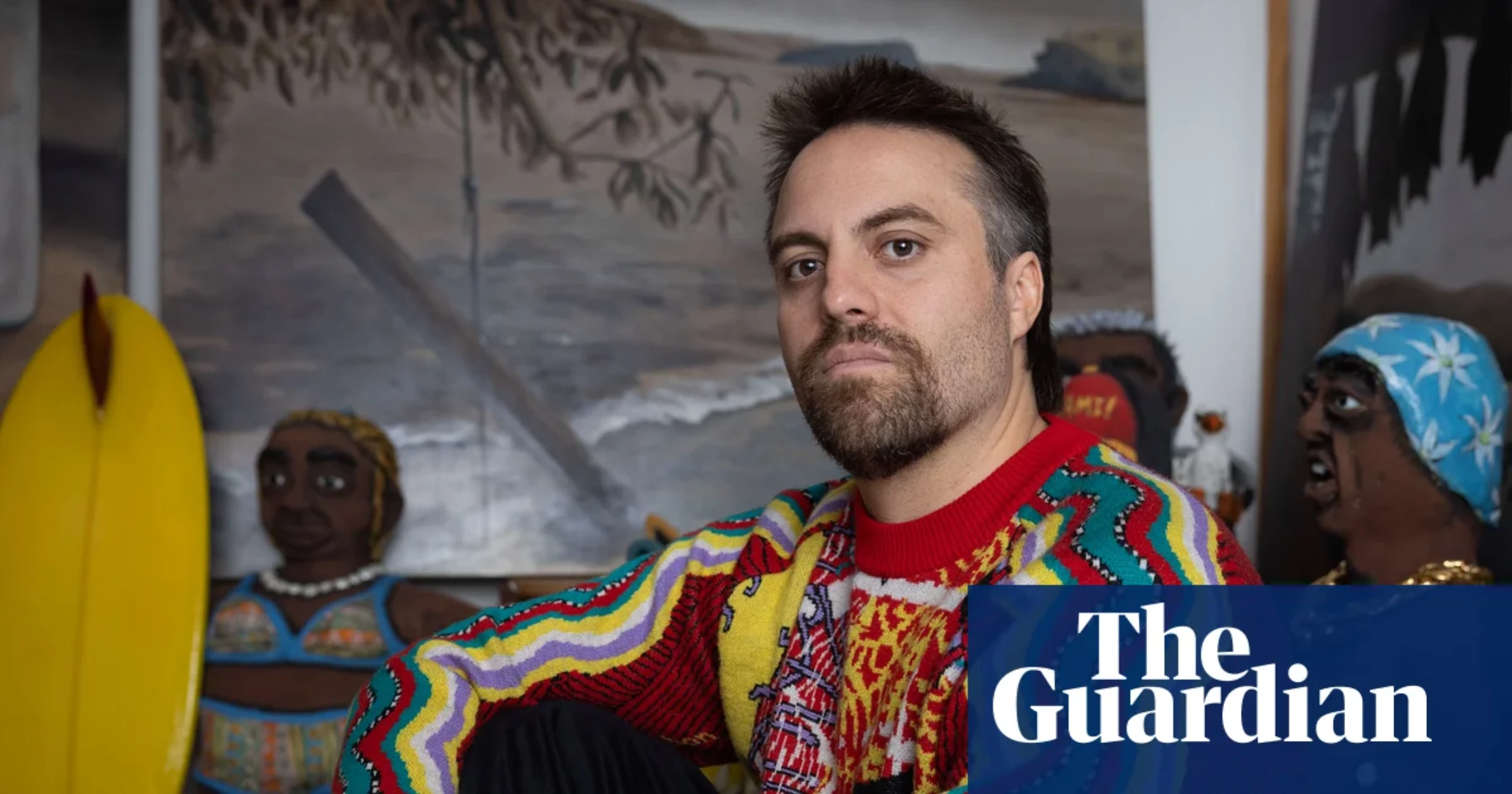
Billy Bain Reclaims Aboriginal Space at AGNSW
Dharug artist Billy Bain uses clay sculptures and landscapes to challenge the "white space" of Australia's northern beaches
Reclaiming the Sand and Waves
The Art Gallery of New South Wales is preparing for a critical intervention in the narrative of the Australian coastline with the solo exhibition "By the River" by Dharug artist Billy Bain. For Bain, the act of surfing on Sydney's northern beaches is not merely a sport, but a form of cultural return and a direct challenge to the erasure of Indigenous presence in predominantly white coastal spaces. Having grown up as the son of champion surfer Rob Bain, the 33-year-old artist experienced firsthand the dissonance of laing as an outsider in a place that is geographically and ancestrally his own. This tension forms the emotional core of his new body of work, which seeks to dismantle the image of the "bronzed Aussie" as the sole occupant of the shore. More on the exhibition details at the Art Gallery of NSW.
Bain's practice is rooted in a profound sense of place and the physical reclamation of space. He describes his experiences as a teenager, where the simple act of surfing was often met with veiled threats of violence and reminders that he did not "belong" in the northern beaches. By centering Indigenous bodies in these spaces, Bain is not just creating art, but performing a political act of sovereignty. His work insists that the beach has always been and remains an Aboriginal space, despite the layers of colonial representation that have attempted to paint it as a white sanctuary.
This reclamation is not an attempt to erase the current reality, but to expand it. By inserting Indigenous figures into the visual lexicon of the Australian beach, Bain is forcing a confrontation with the history of exclusion. The beach is often presented as a site of egalitarianism in Australia, but Bain's work exposes the hidden boundaries that still exist. His project is a study in contrast: the lightness of a summer day versus the heaviness of generational trauma, and the joy of surfing versus the fear of displacement. By merging these elements, he creates a space where the viewer must reckon with the duality of the Australian experience.
Clay Figures and Cultural Totems
The centerpiece of "By the River" is a series of 11 colorful clay sculptures depicting Indigenous family members and a dog, all dressed in quintessentially Australian beachwear: bikinis, shorts, and budgie smugglers. These figures, painted in the red, black, and yellow colors of the Aboriginal flag, serve as a humorous yet subversive counter-image to the stereotypical beachgoer. By employing a "fun, seductive" humor, Bain is able to smuggle complex ideas about sovereignty and inclusion into the gallery space, making the reclamation of the beach feel inevitable and joyful rather than purely confrontational.
The sculptures are anchored by a four-meter soft sculpture of an eel—a totem animal known in the Dharug language as a burra. This piece, constructed from cloth on a wire and steel frame, is adorned with 200 textile elements handwoven by his mother, Kathleen Bain. The eel serves as a powerful metaphor for Bain's own journey: just as the eel spawns at sea and returns to the river systems, Bain sees his artistic and personal trajectory as a return to the country of his ancestors. This integration of familial craft and ancestral totemism transforms the exhibition from a solo show into a collective statement of Dharug resilience.
The use of clay as a medium is itself a statement of connection to the land. Clay is a primal material, extracted directly from the earth, and its use in figurative sculpture allows Bain to ground his subjects in the very soil they are reclaiming. The process of modeling these figures—initially inspired by the wax scraped from his surfboards—bridges the gap between his identity as an athlete and his identity as an artist. This materiality emphasizes the physical nature of sovereignty; it is not just a legal concept, but a tactile relationship between the body and the environment. The resulting figures are not static monuments but lively, breathing representations of a community that refuses to be invisible.
The Landscape as Archive
In a significant evolution of his practice, Bain has introduced five landscape paintings of the Dyarubbin/Hawkesbury river. These works are the result of deep reconnaissance, involving trips with his father in a small boat to find ancient Aboriginal handprints in caves and navigate the clifftops. These paintings do not merely depict nature; they act as archives of presence. By mapping the river system, Bain connects the urbanized environment of Manly to the ancestral lands of the Dharug people, creating a visual bridge between the modern city and the deep time of Indigenous occupation.
Bain's approach to these landscapes is informed by a willingness to engage with the scars of the land. He recounts finding spray-painted warnings on rock art—obnoxious reminders of the ongoing struggle to protect Indigenous heritage from defacement. This tension between the beauty of the river and the violence of colonial oversight permeates the work. The landscapes are not romanticized vistas but are instead markers of survival and persistence, echoing the resilience of the burra eel. For a complete look at his trajectory, including his 2025 Archibald prize finalist entry, visitors can explore the AGNSW digital archives.
By painting these landscapes, Bain is performing an act of cartographic resistance. He is refusing to accept the colonial map as the final word on the geography of the region. Each painting is an exercise in remembering and recording, where the river is treated not as a resource to be managed, but as a living relative with its own memory and agency. This perspective shifts the focus from the aesthetic beauty of the Hawkesbury to its political and spiritual significance, challenging the viewer to see the land not as a playground for the privileged, but as a sacred site of continuous Indigenous habitation.
Healing through Visual Language
For Bain, art has become a primary tool for healing and self-expression. He speaks candidly about the challenges of being color-blind, noting that it initially hindered his confidence in painting. However, this limitation has pushed him toward a more instinctive and emotive use of color. This is most evident in his 2023 self-portrait, painted in raw pink tones following the failed Indigenous voice to parliament vote. The painting, which captures a moment of anger and upset, serves as a stark contrast to the playful clay figures of "By the River," illustrating the breadth of his emotional range and the political urgency of his work.
Bain's refusal to believe that artists exist solely to change the minds of doubters suggests a sophisticated understanding of the gallery's role. He believes that humor and accessibility are more effective tools for reconciliation than direct aggression. While he admits he doesn't know exactly what total reconciliation looks like, his work posits a version of the future where the human spirit's ability to be good-natured allows for a genuine embrace of other people. This philosophy mirrors other healing practices in contemporary art that prioritize internal community resilience over external validation.
Ultimately, "By the River" is more than an exhibition; it is a manifesto for a more inclusive Australian identity, one where the sand and waves are recognized as a shared, sovereign space. By weaving together personal memory, familial collaboration, and ancestral connection, Bain creates a visual language that is both specific to the Dharug experience and universal in its call for justice. The exhibition, which runs from July 4 to November 8, marks a pivotal moment for contemporary Indigenous art in Australia, proving that humor and hope can be just as powerful as rage in the fight for reclamation.