Art Institute of Chicago Acquires Rockwell’s The Dugout, Reframing a Canonical Image as Museum Material
The museum’s first Norman Rockwell purchase places a widely circulated American image into an institutional context shaped by modern and regional narratives.
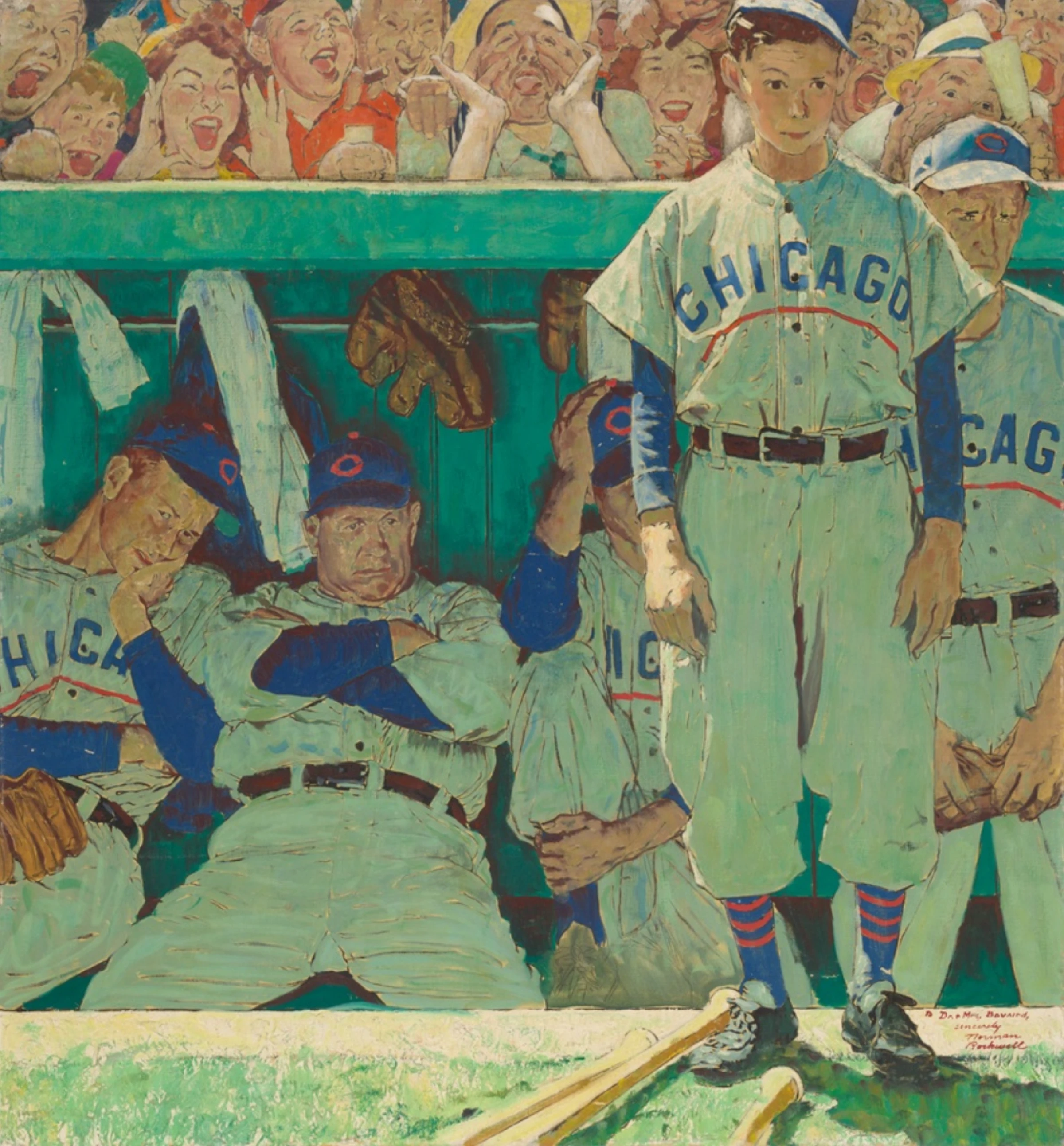
The Art Institute of Chicago has acquired Norman Rockwell’s 1948 painting The Dugout, its first work by the artist. Donated by Bruce and Diana Rauner, the painting is now installed near core works in the museum’s American holdings. The acquisition is notable not because Rockwell lacks recognition, but because institutions have often struggled to position him within a modern art narrative that historically privileged formal innovation over mass-circulation illustration.
Rockwell’s image, produced as a study for a Saturday Evening Post cover, depicts dejected Chicago Cubs players after defeat. The subject is specific and local, but the composition became nationally legible as a scene of collective disappointment, ritual, and endurance. In museum terms, that dual legibility is useful. The painting operates as regional social history and as a study in how popular image systems build national memory.
By acquiring The Dugout, the Art Institute is not simply adding a popular image, it is revising the boundaries of what counts as central American art history within its own galleries. For decades, debates around Rockwell often stalled at a false binary between illustration and fine art. Institutional practice has moved on. Museums now routinely collect objects whose original function crossed editorial, commercial, and aesthetic domains, provided the work has sustained formal and cultural significance.
The timing is also strategic for Chicago. The Cubs’ long arc of civic mythology, including the endurance narratives that predated the 2016 championship, gives the painting local interpretive voltage that visitors can read immediately. Yet the acquisition does not rely on sports nostalgia alone. Rockwell’s handling of group psychology, posture, and compressed narrative space makes the picture a rich teaching object for questions of spectatorship, classed leisure, and postwar American identity.
From a collections-management perspective, the gift underscores how donor relationships continue to shape what enters public institutions at category edges. Works that sit between canonical art history and visual culture often require a donor willing to absorb market timing and transfer the object into an institution prepared to contextualize it rigorously. When that pairing works, museums can rebalance narratives faster than through acquisition budgets alone.
For curators, the challenge now is placement over announcement. Rockwell can be reduced to crowd-pleasing familiarity if interpreted narrowly, or mobilized as an analytical hinge between illustration, painting, publishing, and civic identity. The Art Institute’s installation context will determine which of those paths the work takes. Integrating it alongside established twentieth-century holdings opens a chance to connect visual rhetoric across categories that are usually siloed.
For collectors, the acquisition is another reminder that category prejudice can lag far behind institutional change. Objects long treated as secondary by the market can re-enter major museum narratives when curators identify historical leverage and local relevance. In that sense, this is less about one painting and more about a continuing recalibration of American art value systems.
The museum has framed the work as an opportunity for visitors to encounter a familiar artist in a new institutional setting. That framing is correct. The real development is not that Rockwell appears in Chicago, it is that the institution has chosen to treat this particular image as a durable intellectual asset, not merely a recognizable icon.