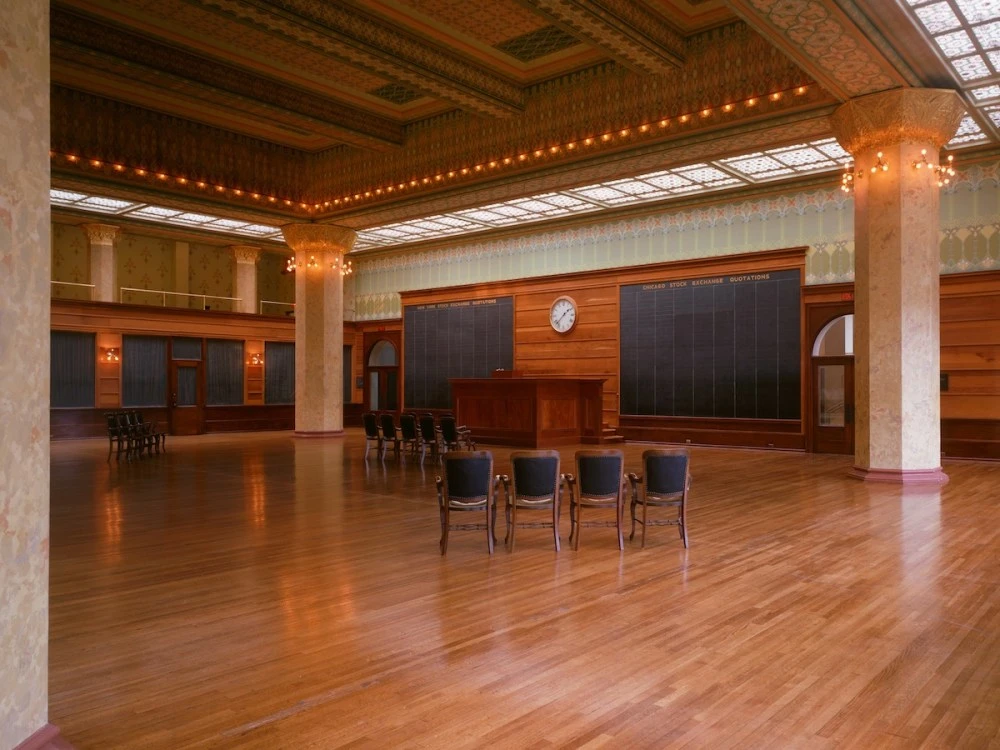
Art Institute of Chicago Expansion Proposal Puts Stock Exchange Room in Focus
A potential expansion plan at the Art Institute of Chicago has revived debate over how the museum should protect and program its historic Stock Exchange Trading Room.
A proposed expansion path at the Art Institute of Chicago has renewed attention on the Chicago Stock Exchange Trading Room, one of the museum's most historically charged interiors. The room, originally built in the 1890s and preserved through major urban redevelopment pressures in the twentieth century, now sits at the center of a familiar institutional conflict: growth versus stewardship.
The initial reporting in public reporting frames the concern clearly. The museum is exploring ways to enlarge gallery capacity, and the Trading Room could be affected by those spatial decisions. Even before architectural details are finalized, the issue has triggered concern because the room functions as more than an event shell or decorative relic. It is a rare intact fragment of Chicago commercial architecture and a living marker of how the museum has historically absorbed and reframed the city's built heritage.
The significance of the room is legible well beyond museum audiences because it is tied to the architectural legacy of the City of Chicago's landmarks framework and to broader debates about adaptive reuse in civic institutions.
Institutionally, the Art Institute has strong precedent for balancing collection growth with architectural complexity, visible across ongoing programming and installations listed in its exhibitions schedule. But the Trading Room is a special case because public expectation around it is emotional as well as scholarly. Visitors read the room as a civic landmark inside the museum, not just as a rentable venue.
Expansion debates of this kind usually narrow too fast into technical language: circulation, adjacency, throughput, flexibility. Those terms matter, but they do not resolve the underlying question of value hierarchy. If a museum retools its footprint, what gets treated as core mission infrastructure and what gets treated as negotiable? With the Trading Room, that hierarchy is now visible in public.
When a museum expands, the hardest question is rarely square footage, it is what kinds of civic memory get re-prioritized in the process.
For Chicago, the outcome will be watched beyond the museum sector because the project touches a broader pattern in city cultural planning: preservation commitments are often strongest in principle and most vulnerable in implementation phases. Once design and fundraising timelines accelerate, symbolic assurances can outpace structural protection.
The Art Institute still has space to shape this process constructively. Clear public communication, early release of design scenarios, and transparent preservation constraints would reduce speculation and improve trust. Institutions that share tradeoffs before final approvals usually preserve more credibility than those that announce completed decisions.
The longer-term stakes are substantial. If the museum can expand while preserving the Trading Room's integrity and public function, it will set a durable institutional model for integrating landmark architecture into contemporary growth. If not, the project risks becoming another case where expansion optics overshadow the cultural memory that made expansion politically possible in the first place.
Chicago's architecture community and preservation advocates will likely demand a phased review structure with published preservation thresholds before approvals are finalized. That kind of process discipline can reduce adversarial escalation and produce better design outcomes.
If the museum engages those constituencies early, it can avoid the false binary between expansion and preservation. Institutions that invite rigorous external critique during planning generally emerge with stronger, more defensible projects.
That broader civic lens is why this story has moved quickly from internal museum planning language into citywide cultural conversation.