Art Institute of Chicago Acquires Norman Rockwell’s ‘The Dugout,’ Expanding Its American Narrative
The Art Institute of Chicago’s first Norman Rockwell work reframes the museum’s American galleries through mass culture, sports identity, and mid-century image politics.
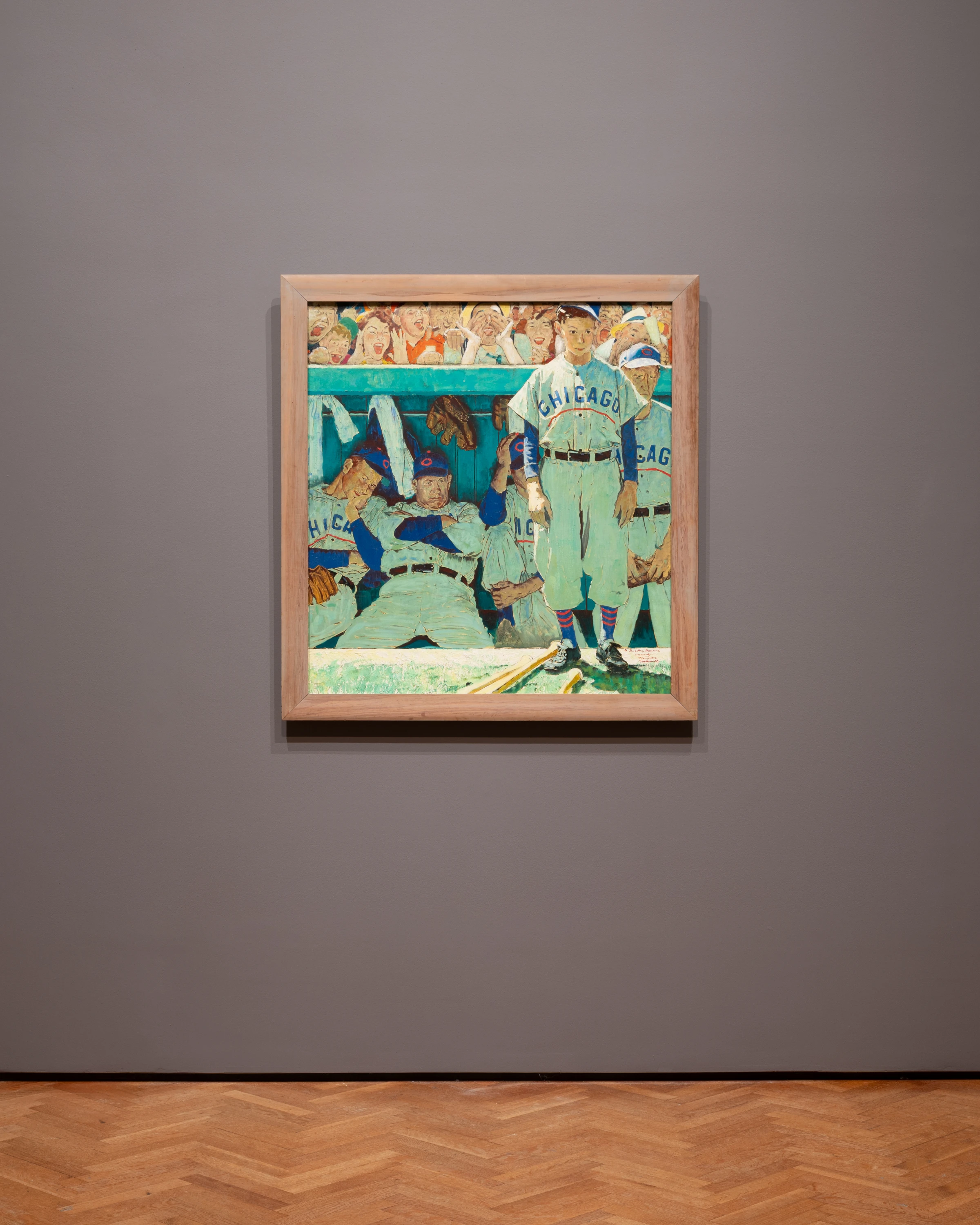
The Art Institute of Chicago has acquired Norman Rockwell’s 1948 painting The Dugout, marking the institution’s first Rockwell accession and signaling a clear curatorial broadening inside one of the country’s most consequential American collections. The work, donated by Bruce and Diana Rauner, depicts Chicago Cubs players in a mood of collective deflation after defeat. It is now installed in proximity to canonical holdings that have long carried the museum’s narrative of American identity. That placement is the story. This is not a token addition in a side gallery. It is a repositioning move inside the main interpretive frame.
Rockwell has historically sat in an uneasy zone between mass reproduction and museum legitimacy. His pictures were built for broad circulation, often first encountered on magazine covers rather than gallery walls. For decades, elite institutions treated that popularity as evidence of sentimentality rather than complexity. Over the last twenty years, that distinction has weakened, partly because curators have become more attentive to visual systems that shape civic life outside formal art spaces. In this context, The Dugout enters the museum not as nostalgia, but as evidence of how images produce social myth, regional identity, and public feeling.
The baseball context is specifically local and therefore strategically useful. Chicago’s long Cubs narrative, equal parts loyalty and disappointment, is a civic language as much as a sports history. Rockwell’s image helped stabilize that language at a national scale, translating a losing team into a durable emotional brand. Museums often claim to represent their cities, but they do so unevenly. By acquiring this work, the Art Institute can address the visual construction of Chicago identity through popular media, not only through high modernism or urban architecture. That is a stronger institutional position because it acknowledges how publics actually form cultural memory.
The acquisition also sharpens current debates about American art categories. In many collections, the hierarchy remains intact: avant-garde experimentation at the top, illustration and commercial culture in a secondary lane. Yet recent scholarship and exhibition practice have made that split harder to defend. Mass-circulation imagery is where political affect, class aspiration, gender coding, and race narratives are often most legible. Rockwell’s work is not exempt from those pressures, and museums that collect it seriously can no longer present him as a harmless chronicler of national innocence. The opportunity is analytical, not celebratory.
For donors and trustees, this acquisition is a reminder that collection strategy now includes audience fluency. Institutions under pressure to justify public value are more likely to invest in works that operate across expert and non-expert publics while still rewarding close art-historical reading. The Dugout can do that in multiple registers: painting technique, print culture circulation, sports iconography, and postwar American mood. It is legible to first-time visitors and still open to rigorous interpretation in university-level teaching contexts.
Operationally, the move may also influence future collecting in Chicago. Once Rockwell enters the core galleries, related questions follow quickly: what other forms of visual popular culture remain under-collected, and which stories have been excluded by inherited definitions of seriousness. The museum now has a chance to build connective tissue between canonical painting, illustration, photography, and civic print culture. That would be a meaningful expansion of the American narrative, and one that aligns with the city’s own complex social history rather than a narrow lineage of approved masterpieces.
At a moment when many institutions are re-evaluating their publics and their categories, the Art Institute’s decision reads as pragmatic and overdue. It accepts that major museums do not just preserve art history, they edit it in real time.