Art Institute of Chicago Adds Norman Rockwell’s ‘The Dugout’ and Repositions American Illustration
The Art Institute of Chicago has acquired Norman Rockwell’s 1948 Cubs painting, a move that quietly expands how major museums frame mid-century American image culture.
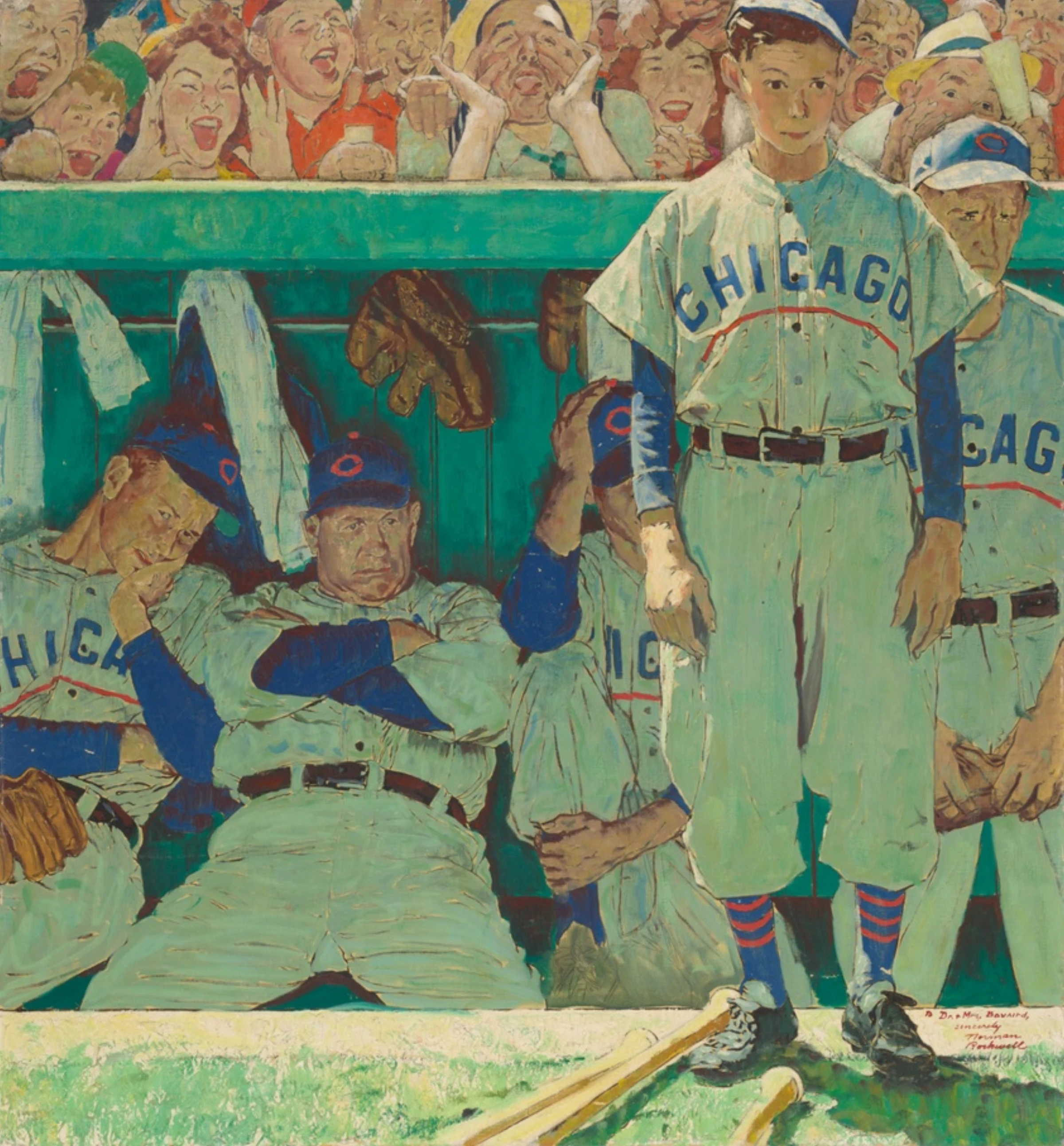
The Art Institute of Chicago has acquired Norman Rockwell’s The Dugout (1948), its first work by the artist, through a donation from Bruce and Diana Rauner. On paper, the move reads like a civic-identity acquisition, Chicago baseball iconography entering a Chicago museum. In curatorial terms, it is larger than that. The work introduces a different visual economy into the galleries, one grounded in circulation, magazine readership, and mass narrative rather than singular avant-garde prestige.
The painting’s backstory matters. Rockwell developed The Dugout as a substantial oil study for a Saturday Evening Post cover image at a moment when the Cubs’ losing identity had become part of US sports folklore. Because the picture was built for broad publication culture, not for salon display, it sits at the junction of fine art and editorial illustration. When an institution of AIC’s scale places it in dialogue with canonical American works, it revises hierarchy as much as holdings.
That revision has practical consequences for collecting strategy. Museums have spent two decades widening their understanding of American visual history, adding design, photography, vernacular image practices, and historically marginalized makers. Rockwell has always been popular with publics, but museum treatment has often lagged because his production was tied to commercial commission structures. Acquiring The Dugout acknowledges that commercial context is not a disqualifier. It is part of the object’s historical intelligence.
For curators, the key challenge now is interpretive framing. If Rockwell is shown as nostalgic Americana alone, the acquisition underdelivers. If it is staged as evidence of postwar narrative construction, class performance, masculinity scripts, and media distribution, then the work can activate the surrounding gallery in productive ways. The museum has a strong opportunity to use labels, digital interpretation, and public programming to place illustration culture in relation to museum painting traditions rather than outside them.
For collectors, this is also a signal about category movement. Institutional validation of iconic illustration-linked works can reorder private demand, especially when those works are attached to nationally legible stories. Yet this does not mean every legacy illustration object will reprice upward. Museums are not buying sentiment. They are buying objects that can carry art-historical argument in public. Provenance clarity, condition, and cultural legibility still decide outcomes.
Chicago-specific context adds another layer. The placement of The Dugout among established American holdings invites local audiences to read civic mythology through museum space, where victory is absent and disappointment is central to the picture’s emotional charge. That is a sophisticated narrative choice. The work is not triumphalist sports branding. It is a study of collective deflation rendered with extraordinary control of gesture and staging.
If the Art Institute sustains this line, the acquisition will stand as more than a crowd-pleasing addition. It will mark a methodological shift, where museum-quality American art is defined less by old medium hierarchies and more by an artwork’s capacity to organize social memory, visual literacy, and historical argument for contemporary publics.
It also opens a useful teaching corridor between popular print culture and contemporary image ecologies. Rockwell’s compositional strategies, facial choreography, and timing cues are legible to audiences trained by advertising and digital feeds, which gives museum educators a bridge into slower looking and historical method. Institutions such as the Norman Rockwell Museum have long argued for this interpretive depth, but integration into encyclopedic museum galleries changes the scale of that argument.
For Chicago, the acquisition is likely to perform well with broad audiences, yet its long-term value will depend on curatorial follow-through. Pairings with labor history, sports media, and postwar publishing archives could push discussion beyond nostalgia and toward infrastructure, who produced images, who distributed them, and who controlled the narratives they carried.