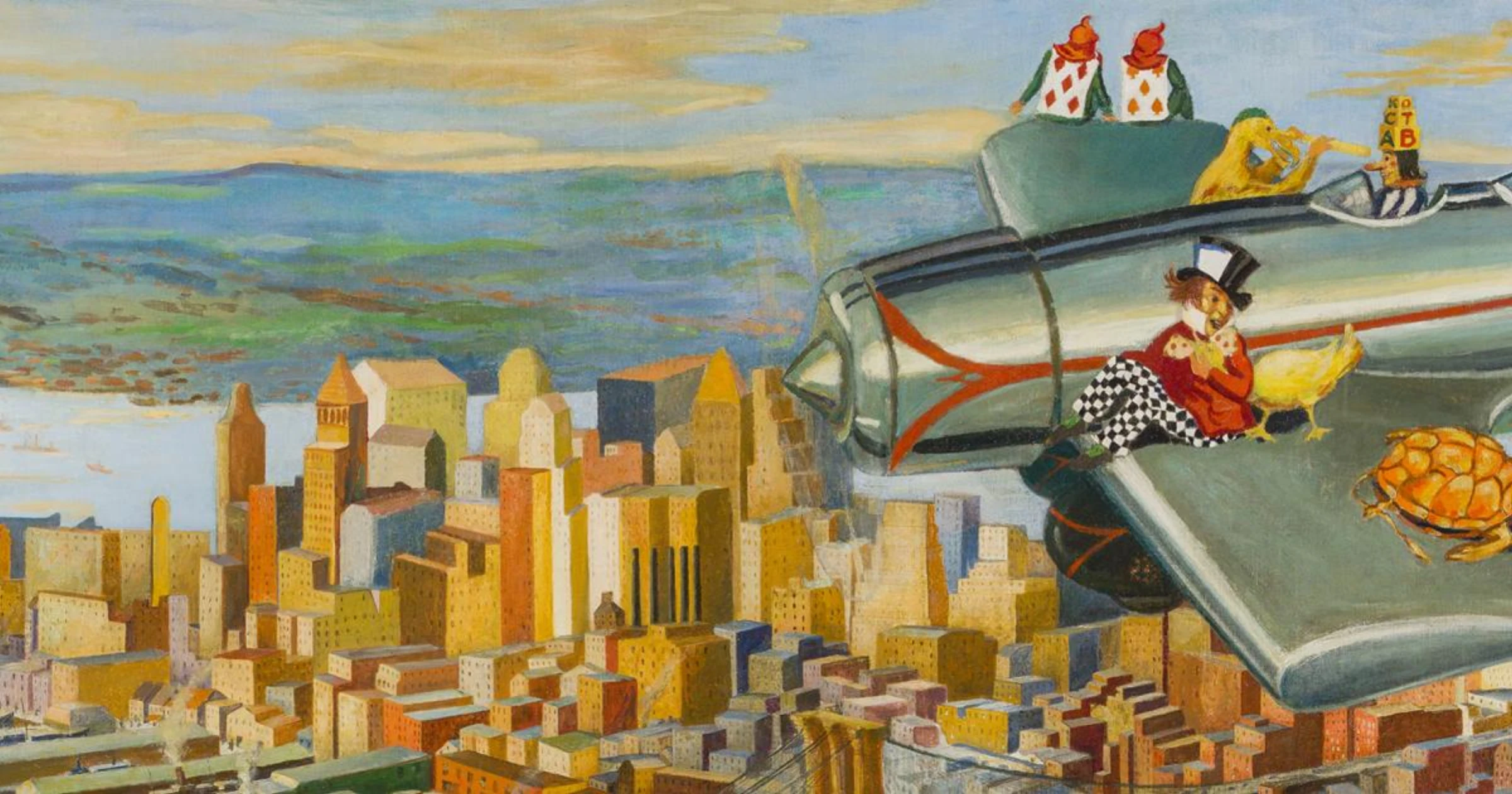
Rescued WPA Alice Mural Returns to Public View in New York
MCNY’s Abram Champanier exhibition is not just a rediscovery story - it is a hard lesson in how public art survives only when someone fights for it
The return of Abram Champanier’s mural is a rescue story with institutional teeth
The most revealing detail in the Museum of the City of New York’s presentation of Another Wonderland: Abram Champanier’s Alice Mural is not that the work is charming, though it is, or that it stages Alice, the Mad Hatter, and the Cheshire Cat against a Depression-era New York skyline, though that visual conceit still lands. It is that the mural survived at all. As The Art Newspaper reported, the sixteen-panel WPA cycle was created between 1938 and 1940 for the children’s ward at Gouverneur Hospital on the Lower East Side, then nearly lost when the original building was abandoned and marked for renovation. Fifteen panels were salvaged in 1981 after a volunteer effort led by conservators Denise Whitbeck Farancz and Alan Farancz. The exhibition at MCNY is the first time the surviving cycle has been reunited and shown publicly in full since that rescue.
That backstory matters because it turns what could have been a sentimental exhibition into a case study in how public art slips into danger when no institution claims durable stewardship. Champanier’s mural was commissioned through the WPA for a hospital children’s ward, one of eighteen murals made for public New York hospitals and the only surviving example created specifically for such a pediatric setting. In other words, this was never a minor decorative work. It was part of a state-backed theory of what art could do in a civic healthcare environment: offer delight, transport, and dignity to children who were ill, scared, or stuck in institutional space. When the building changed, the city did not have a ready system to protect that premise. Volunteers and conservators did.
Why the mural looks different now than it did as hospital decoration
MCNY’s installation gives the work a new kind of legibility. In the hospital, the panels were immersive infrastructure, surrounding rows of beds and turning the ward into a theatrical New York fairy tale. In the museum, the mural becomes visible as both image cycle and artifact of public policy. Alice and her companions ride the subway, hover over the Statue of Liberty, occupy the New York Public Library lions, and drop into Coney Island with the manic confidence of a city imagining itself as a democratic wonderland. That matters because WPA mural programs were never just aesthetic projects. They were exercises in civic narration. They asked who belonged in a public building, what kind of visual pleasure ordinary people deserved, and how government could stage cultural optimism during crisis.
Champanier’s biography sharpens that story. He was a Jewish immigrant from Russian Poland who arrived through Ellis Island, studied at the Art Students League, and worked across New York before later teaching in Woodstock. According to the exhibition materials cited by MCNY and The Art Newspaper, he even inserted his own jester-like character, Fabzio the Toymaker, as Alice’s guide. That gives the mural a personal tilt inside its public commission: an immigrant artist translating literary fantasy, urban spectacle, and civic aspiration into a healing environment for largely immigrant children. It is hard to think of a cleaner rebuttal to the idea that public art is secondary to the museum canon. The mural did urgent social work before anyone called it heritage.
The real subject is stewardship, not nostalgia
Rescue stories can become self-congratulatory fast. Institutions love a near-loss narrative because it lets them inherit moral seriousness from the object. MCNY is mostly avoiding that trap because the exhibition keeps the conservation and custody story in view. The mural was not magically rediscovered. It survived because a handful of people decided the city’s indifference was unacceptable, hauled the panels out in brutal conditions, restored some of them over time, and kept the remaining works in limbo until funding arrived decades later. Larissa Trinder of NYC Health + Hospitals Arts in Medicine has said completing the cycle became a priority because the mural belongs to the patients and communities for whom it was made. That is the right claim. It frames the object not simply as a rescued treasure but as unfinished public responsibility.
This is also why the planned post-exhibition installation at Gouverneur matters as much as the museum show. After the exhibition closes, the panels are due to return to the hospital’s current location on Madison Street, with some placed so they can be seen from the street. That move resists a familiar museum reflex: removing a public object from its civic setting and treating the museum as the work’s natural destiny. MCNY can provide scholarship, preservation, and visibility. But the mural’s historical meaning remains tied to healthcare, public access, and neighborhood life. Returning it to that orbit, while still acknowledging the museum’s role in telling the story, is a more honest solution than permanent absorption into a fine-art frame.
The question this raises for other institutions is uncomfortable and overdue. How many murals, design programs, and public commissions commissioned for schools, hospitals, transit systems, and municipal buildings are now one renovation away from erasure? artworld.today recently published a guide on reading institutional signals in cultural programming, using the season’s exhibition rhetoric to spot real priorities. The Champanier case offers a harder version of the same lesson: preservation priorities become visible when a work is inconvenient, not when it is already celebrated.
The object itself rewards that attention because it is not simply a pretty relic. Champanier translated a canonical literary property into an urban map of aspiration, one in which public landmarks, transport, harbor life, and leisure culture become part of a child’s imaginative survival kit. That makes the mural a rare document of how the city once pictured its obligations to young patients. The work says that civic institutions should not merely contain vulnerable people; they should offer them beauty, humor, and orientation. That philosophy now feels both generous and strangely radical.
It is also worth lingering on the fact that only fifteen of the sixteen panels survive. Missing fragments change how rescue gets remembered. Preservation is often narrated as triumph, but most saves are partial and compromised. One panel vanished. Others spent decades in storage or restoration limbo. The mural returns marked by interruption, which is part of why the exhibition feels more serious than heritage spectacle. It tells the truth about how fragile public art becomes once a building’s practical life changes and no clear administrative system exists to defend the work inside it.
For New York museums, that should trigger institutional self-scrutiny. The city has enormous expertise in exhibition-making, but it has not always shown equal consistency in caring for art embedded in hospitals, schools, and municipal architecture. The Champanier case exposes the divide between the city’s confidence in museum culture and its shakier commitment to preserving art made for everyday public use. If visitors leave MCNY seeing only a whimsical Alice narrative, they will miss the sharper point. The exhibition is also a ledger of what neglect looks like before an object becomes fashionable enough to save.
What comes next for the mural and for the politics of public care
The exhibition runs through late September, but its larger value will be measured by what it changes in New York’s public-art imagination. MCNY has a chance to make visitors see the mural not as an eccentric survivor from a nicer era, but as evidence that cities once understood hospitals, children, and public culture as interdependent. That is a tougher message now, when healthcare institutions are financially strained and public art is often treated as branding. The mural’s survival says something blunt: environments of care are shaped by visual choices, and those choices deserve preservation budgets, not just retrospective praise.
If the installation at Gouverneur succeeds, the mural will regain some of the social life it originally had, even in altered form. People on the street will see pieces of it. Patients and families will encounter it in a functioning facility rather than in a sealed art-historical past. That is a better ending than permanent museum custody, and a more demanding one because it commits the city to ongoing stewardship. The work’s reappearance therefore lands as more than a feel-good rediscovery. It is a reminder that public art in public institutions is only as safe as the systems built to defend it. MCNY has delivered the reunion. New York now has to prove it learned the lesson.
There is an additional lesson in the mural’s hospital origin. Art in healthcare settings is often discussed today as a wellness supplement, something pleasant that softens institutional stress. Champanier’s mural suggests a more ambitious standard. It treats visual culture as part of public care itself, not as a therapeutic extra once everything else is handled. That distinction matters because it restores political weight to decoration. In the right context, a mural is not background. It is evidence of what a city thinks vulnerable people are owed.
That perspective also complicates the easy division between fine art and social utility. The mural was built to function inside a children’s ward, yet that practical role is exactly what gives it emotional and historical force now. It demonstrates that art made for use can carry aesthetic ambition without apology. Museums frequently honor that principle in theory while still privileging autonomous objects in practice. Champanier’s return offers a corrective by showing how civic function can deepen, rather than diminish, artistic meaning.