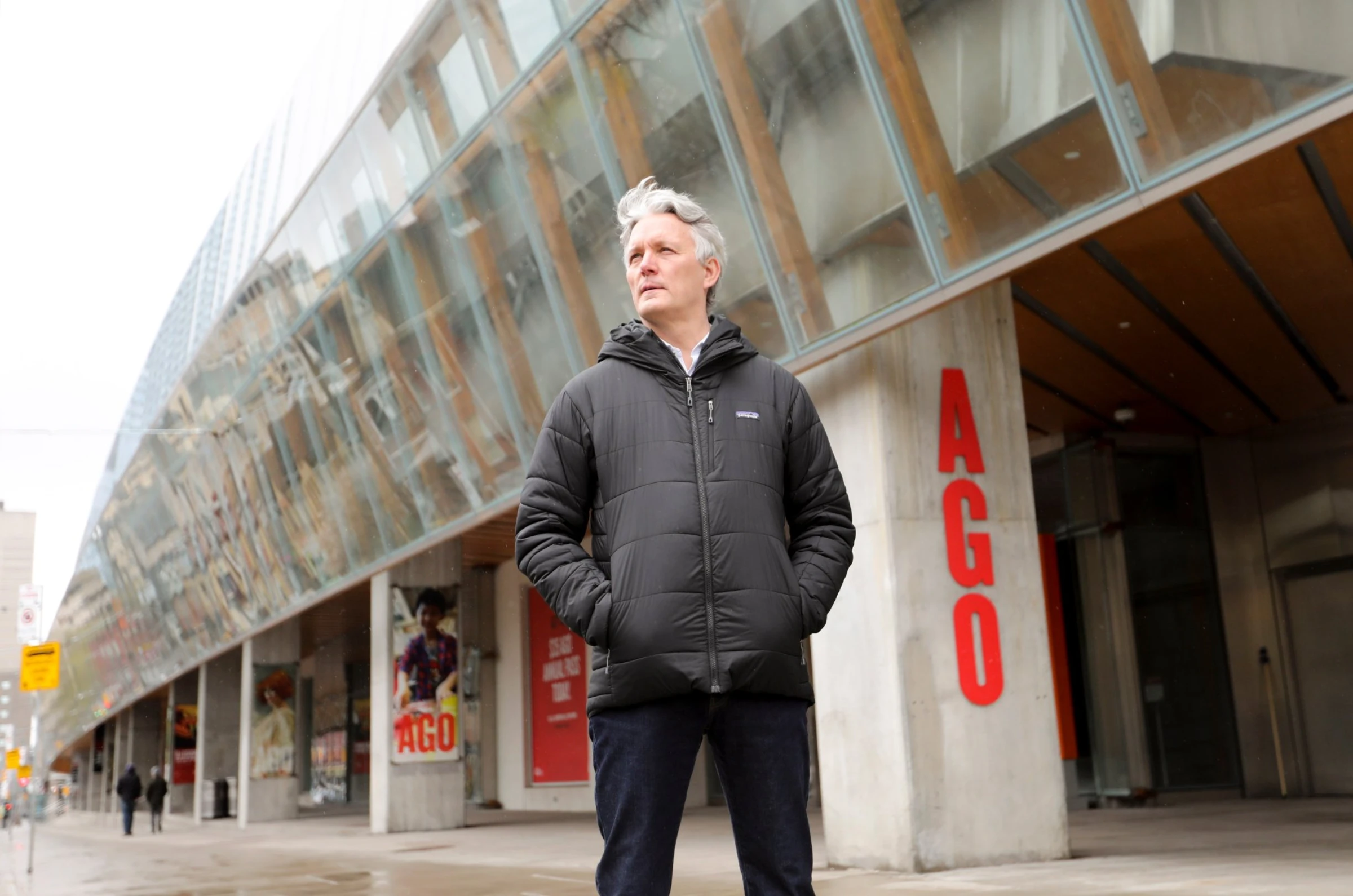
Chief Curator Julian Cox to Leave Art Gallery of Ontario After Eight Years
Julian Cox will step down as deputy director and chief curator of the Art Gallery of Ontario on April 13, concluding a tenure shadowed by the museum's controversial withdrawal from a Nan Goldin acquisition.
Julian Cox will leave his position as deputy director and chief curator of the Art Gallery of Ontario (AGO) on April 13, the institution confirmed on March 9. His departure concludes an eight-year tenure in which Cox held dual administrative and curatorial authority, shaping the museum's acquisition program and exhibition schedule through a period of significant institutional turbulence.
Cox's exit comes in the wake of a controversy that has unsettled the AGO's leadership and acquisition committee over the past several months. The museum had been positioned to co-acquire Nan Goldin's 2024 video work Stendhal Syndrome in partnership with the Vancouver Art Gallery and the Walker Art Center in Minneapolis. The deal collapsed after members of the AGO's acquisition committee characterized Goldin's public comments about Israel's war in Gaza as antisemitic. The cancellation triggered a cascade of departures: John Zeppetelli, a curator of modern and contemporary art at the institution, resigned, as did two committee members. According to Artforum, Cox's departure has not been formally connected to the Goldin controversy.
The intended acquisition of Stendhal Syndrome would have been a significant institutional statement. Nan Goldin, one of the most influential figures in contemporary photography, has in recent years positioned herself explicitly within political debates, including sustained advocacy around the opioid crisis through the group PAIN. Her work's presence in a shared institutional context, involving three major North American museums - the AGO, the Vancouver Art Gallery, and the Walker Art Center in Minneapolis - carried implications well beyond any individual collection decision. The AGO's withdrawal reverberated precisely because the deal had reached an advanced stage of commitment, and because the stated rationale was read widely as a form of ideological gatekeeping.
AGO director Stephan Jost, in a statement released Monday, praised Cox's contributions without addressing the surrounding controversy. 'Julian has had a profound and positive impact on the AGO,' Jost said. 'The quality and appeal of the AGO's exhibitions, the significant growth of the collection, and his deep commitment to scholarship, all stand as hallmarks of his successful tenure. On a personal note, we will greatly miss his collegiality, leadership, and generosity of spirit.'
Cox's departure leaves a dual vacancy at a museum that has seen considerable institutional strain. The AGO has been navigating the intersection of collection decisions with political and cultural pressures that make straightforward curatorial judgment increasingly contested. The Goldin episode illustrated how acquisition committees, historically understood as insulated technical bodies, have become sites where broader political commitments are made visible - with consequences for staff, morale, and public perception.
The timing also raises questions about the museum's near-term curatorial direction. Cox served as both chief curator and deputy director, a configuration that concentrated strategic oversight in a single figure. Identifying a successor with comparable authority will take time, and that process will unfold against a backdrop of institutional scrutiny that the Goldin controversy has intensified. The museum has not yet announced a formal search.
For the field more broadly, the AGO situation is legible as a case study in the limits of institutional neutrality. Museums have long preferred to frame acquisitions and deaccessions as purely scholarly or market-driven decisions. The past several years have made clear that such framing is increasingly untenable. Stakeholders, funders, and the public read collection decisions as value statements, and institutions that do not acknowledge this openly expose themselves to the kind of credibility challenges the AGO is currently managing.
Cox's next position has not been announced. His departure date of April 13 suggests an orderly transition rather than an abrupt exit, but the circumstances surrounding the final chapter of his eight-year tenure will shape how his record at the AGO is assessed.