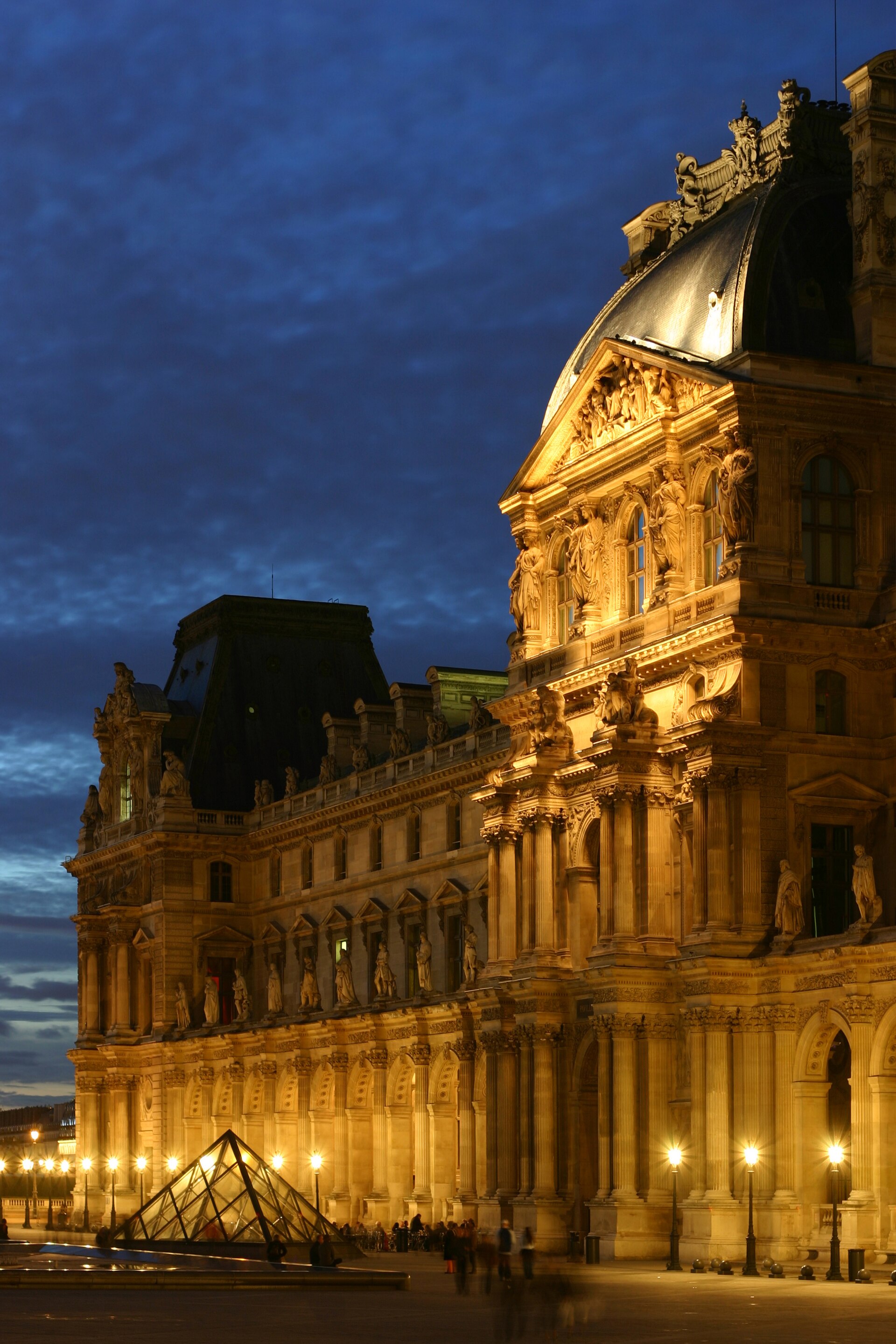
Activists Install Framed Prince Andrew Arrest Photo Inside the Louvre
A guerrilla action at the Musée du Louvre reframed a viral arrest image of Andrew Mountbatten-Windsor as political portraiture, pushing museum spectatorship into direct confrontation with power and impunity.
Activists linked to the Everyone Hates Elon campaign mounted a framed post-arrest photograph of Andrew Mountbatten-Windsor at the Musée du Louvre on February 22, turning one of the world’s most choreographed museum interiors into a site of immediate political address. The image, documented in social posts by the group, showed the former prince inside a police vehicle shortly after his February 19 arrest. The impromptu wall label, according to published documentation of the action, read "He’s Sweating Now."
The wording was deliberate. It referred to Mountbatten-Windsor’s widely discussed 2019 television interview, in which he claimed a medical inability to perspire while denying allegations connected to Jeffrey Epstein. By folding that earlier statement into a concise caption, the activists treated text as curatorial weapon: one sentence, one image, one loaded reversal. Museum viewers were asked to read the picture not as celebrity scandal but as a document of delayed accountability.
The intervention was less about adding one more image to a museum and more about forcing an institutionally framed encounter with a man many see as a symbol of elite immunity.
The action also follows the campaign’s broader pattern of staging confrontational visual interventions around billionaire and political power. Their prior projects have included large-format public displays targeting figures tied to concentrated wealth and high-profile abuse networks. In that context, the Louvre operation reads as a tactical escalation. Instead of billboard space, the group temporarily occupied the architecture of cultural legitimacy itself.
Whether one views the act as activist theater, institutional critique, or media spectacle, it exposed a persistent fault line in contemporary museum culture: institutions can expertly frame historical violence while remaining structurally uneasy when current power enters the frame. The campaign exploited that hesitation. The placement of a recent arrest image in an encyclopedic museum did not collapse art and politics, it clarified how inseparable they already are for audiences who no longer accept neutral spectatorship as an option.
The museum had not issued a public comment at publication time in the cited reporting. That silence is now part of the work’s afterlife. The intervention’s material duration was brief, but its social circulation will be longer, especially because it mobilized familiar museum codes, frame, wall text, placement, toward a different end. A conventional hanging is meant to stabilize meaning; this one destabilized it.
A second layer of the action concerns circulation economics. The image did not gain force from rarity, it gained force from repetition across platforms that already distribute outrage at scale. By relocating that same image into a canonical museum setting, the activists converted a scrolling news artifact into a deliberative object, asking viewers to pause and interpret rather than consume and move on. That shift from feed velocity to gallery attention is now a central tactic in activist visual culture.
What matters next is not only whether similar actions proliferate, but whether institutions develop a coherent public language for politically charged unsanctioned interventions. For now, the Louvre incident is a marker of the moment: activists are no longer satisfied with criticizing institutions from outside; they are increasingly using institutional display itself as the medium. It was a brief gesture, but it reset the terms of who gets to author meaning inside elite cultural space.