How Young Galleries Survive New York in 2026
A practical guide to how emerging dealers are balancing fairs, rent, collectors and identity in New York's punishing but still indispensable art market
Why New York still matters even when the math looks hostile
Every few years the art world rediscovers the same complaint: New York is too expensive, too accelerated and too ruthless to sustain genuine experimentation. In 2026 that complaint has fresh fuel. Josh Kline's essay on real estate and artistic ruin sharpened a long-running argument about whether the city still deserves its mythic centrality. Yet the behavior of young dealers this May tells a more complicated story. As The Art Newspaper reported from Frieze week, emerging galleries are not fleeing New York en masse. They are recalibrating how to survive inside it.
This guide is not a romantic defense of hardship. New York can burn through money, attention and stamina with unusual efficiency. But it remains the city where collector density, institutional visibility, media amplification and art-historical symbolism converge most intensely in the United States. For a young gallery, that concentration still matters. The question is no longer whether New York is sustainable in the abstract. The question is how galleries can extract the advantages of being here without adopting a cost structure that destroys them before their program coheres.
The most useful lesson from the current cohort is blunt: survival in New York has less to do with appearing big than with understanding what kind of presence actually converts into relationships, sales and long-term identity. That means thinking about fairs, rent, programming, estates, staffing and location as one interlocking system rather than as separate tactical choices.
Use fairs selectively, not as a default growth machine
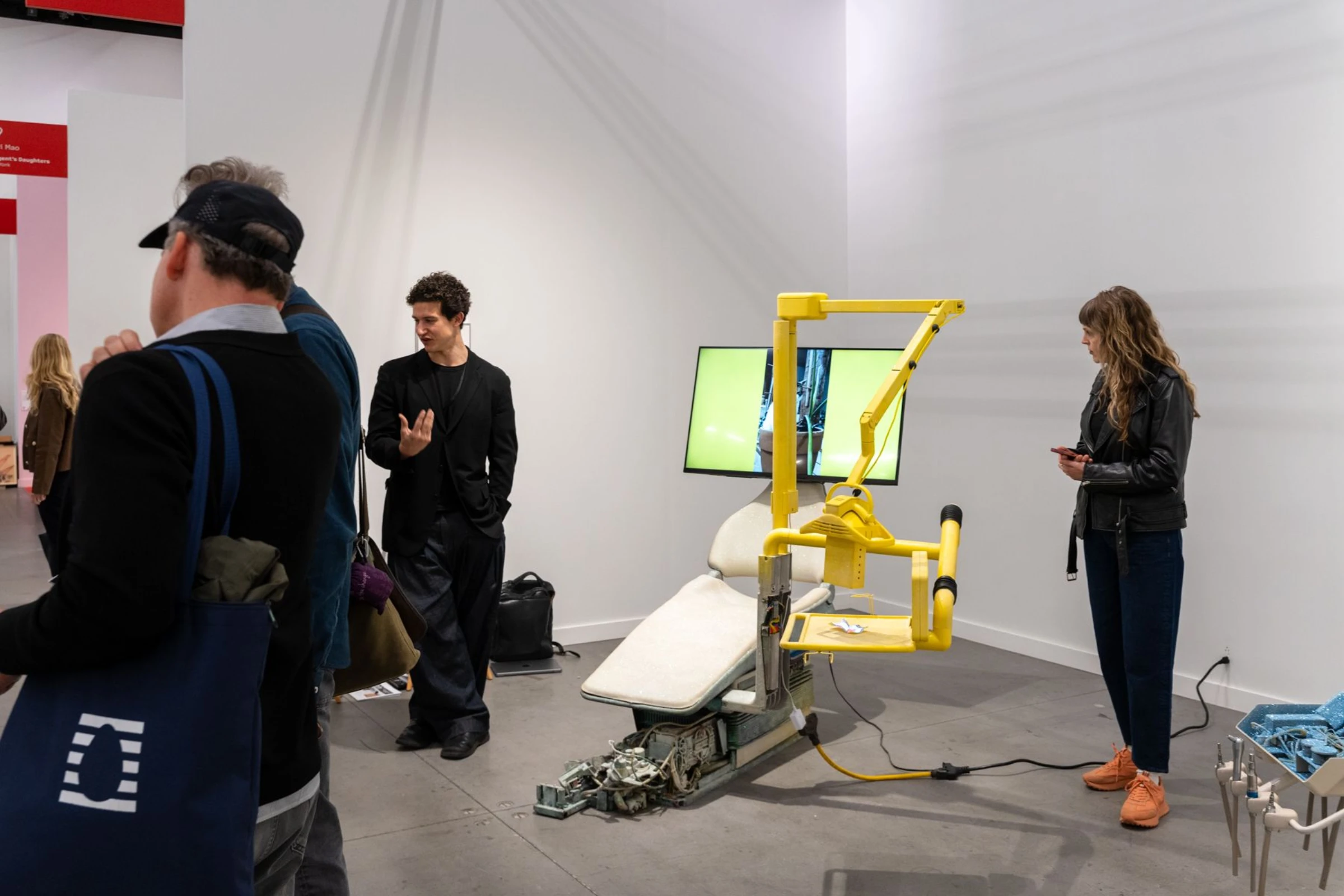
For many younger dealers, fairs are no longer simple opportunities for exposure. They are capital allocation decisions that can either compress a year of visibility into one week or drain a fragile balance sheet in the name of relevance. The dealers quoted in The Art Newspaper piece are instructive because several are doing the hard thing correctly: using fairs asymmetrically. Europa, for instance, showed Aki Goto's less overtly commercial installation in Frieze Focus, where lower booth costs create space for curatorial risk, while also placing paintings at Independent to widen its chances of actual revenue. That is not dilution. It is segmentation.
The principle is straightforward. Not every fair needs to serve the same function. One can be for visibility, another for liquidity, another for institutional courtship. What destroys young galleries is treating every fair as a referendum on prestige. Frieze Focus, Frieze New York, Independent and smaller ecosystems like Esther each attract different forms of attention. The right question is not, "Can we get in?" It is, "What specifically are we trying to get from being there?" If the answer is vague prestige, the stand probably costs too much.
Emerging dealers should also model success in concrete terms before they commit. How many works need to sell to cover the booth, shipping, installation, travel and lost staff time? Which collectors are likely to show up in person? Which curators are easier to reach at the fair than in your gallery? Too many galleries approach these questions emotionally after acceptance letters arrive. By then the fair has already won. Better practice is to define the break-even point, the upside scenario and the reputational downside in advance.
Keep overhead lean enough to protect programming freedom
One of the cleanest quotes in the source report comes from Sam Gordon of Gordon Robichaux: the key is not to incur debt. That sounds obvious until one remembers how much of the gallery ecosystem is built on the performance of scale. Large spaces, expanded payrolls and increasingly elaborate fair participation can make a young gallery look established while quietly making it structurally weak. A gallery that needs $60,000 every month just to break even has already narrowed its curatorial imagination. It must sell constantly, and that sales pressure inevitably shapes the program.
Protecting programming freedom means designing an operating model that can survive uneven cash flow. In practical terms, that may require a smaller space, longer exhibition cycles, lower fixed staffing costs and a clear refusal of vanity expansion. New York punishes vagueness here. If your gallery cannot articulate why it needs a larger footprint, Tribeca address or second space, the city will convert that uncertainty into rent.
There is also a psychological advantage to lean operations. Dealers with lower overhead can say no more easily: no to a bad fair, no to a weak collector demand, no to representation that stretches the program beyond coherence, no to growth that arrives before infrastructure. Saying no is not caution for its own sake. It is how a young gallery avoids becoming a service provider for a market it does not actually control.
Maintain physical presence because serious collectors still buy in person
Digital visibility is indispensable, but the galleries highlighted this week all keep returning to the same point: serious collecting still depends on embodied trust. Silke Lindner put it crisply when she said most of her sales are to New York collectors and that a physical presence is necessary to cut through the noise of online images. That observation should not be dismissed as old-world habit. Art is still a scale-based, surface-based, context-sensitive medium. The best collectors want to see objects, not just documentation, and they want repeated encounters with the people framing those objects.
This does not mean every young gallery needs a huge permanent venue. It means there must be some credible form of place. That might be a boutique space, a shared address, a disciplined project room or a calendar of regular appointments that turn a modest premises into a dependable meeting point. The key is consistency. If collectors and curators do not know where and how to find the gallery's mind, the gallery becomes just another image feed.
Physical presence also shapes discourse. Artists talk differently in rooms than in captions. Collectors spend time differently around work than while scrolling. Curators take risks differently when they can be walked through a program by someone who knows how each exhibition speaks to the next. These are not sentimental claims about the magic of in-person culture. They are operational facts about how trust and conviction accumulate in the primary market.
Build a program with temporal depth, not just fresh names
A striking thread in the New York week coverage is how many younger dealers are pairing emerging artists with estates or under-recognized historical figures. Ulrik's work with Bettina, Gordon Robichaux's engagement with Jenni Crain and other cross-generational strategies all point toward the same insight: it is easier to build collector confidence when a gallery's program feels historically anchored. This is not merely a commercial trick. It is a way of declaring that a young gallery has intellectual commitments broader than trend detection.
Programs with temporal depth can do three valuable things at once. First, they help collectors understand younger artists through lineage rather than hype. Second, they create opportunities for scholarship, loans and institutional dialogue that a purely novelty-driven program may struggle to secure. Third, they diversify the gallery's risk profile. An estate or overlooked historical practice can stabilize a calendar that might otherwise depend on very early-career production. This is one reason fairs and institutions alike still pay close attention to estate-driven research presentations at events tied to the New York critical scene and to museum acquisition patterns that reward context, not just novelty.
The danger, of course, is opportunism. Estates are not shortcut prestige objects. A young gallery that takes on archival material without real research capacity can quickly look extractive or confused. The standard should be whether the historical material genuinely clarifies the gallery's editorial position. If it does, the result can be powerful. If it does not, the gallery becomes a reseller of dead reputations.
For dealers making these decisions now, resources like the Brooklyn Museum, collector networks built around downtown history and artist estates with underdeveloped scholarship offer meaningful terrain. But the point is not to chase any estate. The point is to create context strong enough that collectors are buying into a program, not just a booth.
Choose geography for identity, not trend compliance
The migration of galleries within New York is often narrated as a simple move toward whatever neighborhood currently signals momentum, but younger dealers should be more skeptical. Tribeca may be the city's current gallery nexus, yet not every gallery benefits from joining the same map. Gordon Robichaux has no interest in leaving Union Square. That kind of refusal can be strategic. Location is not just foot traffic; it is also identity, rent structure and the kind of audience a gallery can plausibly cultivate.
At the same time, the article's examples show why New York's internal geography remains active rather than settled. Southern Guild's move from Los Angeles to Tribeca, Gratin's expansion, Tappeto Volante's Manhattan opening and the changing layout of fairs all demonstrate that the city is still reorganizing itself around where collectors actually spend time. Young galleries should read those movements carefully, but not mimic them blindly. A move should answer a precise need: better collector access, stronger neighboring programs, lower operational friction or a location that fits the artists' scale and audience.
There is also the broader comparison to other cities. Daisy Sanchez of Hans Goodrich makes the Chicago case plainly: lower rent, more freedom, less saturation. That is real. If your program depends on experimentation that New York's economics would suffocate, another city may be the better base. But even then, New York can remain a strategic outpost rather than a full-time home. Pop-ups, fair participation and short, concentrated runs may deliver many of the same collector benefits without importing the full cost structure of permanent residency.
Plan for stamina, because burnout is an economic problem too
One thing the glamorous language of May often hides is that gallery survival is not just financial. It is temporal and emotional. Running between fairs, maintaining a permanent program, tracking payments, supporting artists and managing expectations can turn every season into a fatigue test. Burnout is usually described as a lifestyle issue, but for young galleries it is also an economic one. Exhausted dealers make poor bets. They overcommit to fairs, underprice labor, neglect follow-up and lose the ability to think strategically about their own program.
Good operations are therefore not secondary to taste. They are what allow taste to endure. Galleries should build calendars that include dead time for planning, artist care and financial review. They should define who handles collector follow-up, how shipping decisions are made, what documentation standards are non-negotiable and where administrative support becomes necessary. None of this sounds romantic. That is exactly why it works. The galleries that last are often the ones that treat administration as part of artistic seriousness rather than as an embarrassing sign of commerce.
Emerging dealers should also be honest about the symbolic traps of New York. The city flatters ambition while normalizing chaos. Being constantly busy can feel like relevance even when it is just churn. A gallery that wants to survive here must learn to distinguish between visibility and advancement. Not every invitation deserves a yes, not every fair deserves a booth, not every expansion deserves a signature. New York remains indispensable for many dealers, but only if they refuse to let the city set all the terms.
The practical playbook for 2026
Put the lessons together and a workable playbook emerges. Use fairs with differentiated goals. Protect the balance sheet by avoiding debt-driven scale. Keep a physical presence because collectors still buy conviction in person. Build programs with historical depth so the gallery stands for more than novelty. Choose neighborhood strategy according to identity and cost, not herd instinct. Treat operations and stamina as part of curatorial intelligence.
This may not sound glamorous, but it is more useful than glamour. The strongest young galleries in New York are not winning because they solved the city's structural cruelty. They are winning because they learned how to metabolize it without letting it dictate the whole program. For artists, the city may still look like a machine that eats freedom. For dealers, it remains a machine worth entering if they know what not to feed it first. In 2026, survival in New York is not about believing the myth. It is about using the city hard, precisely and on your own terms.