How Overlooked Female Old Masters Get Found
From Clara Peeters to Artemisia Gentileschi, the methodology behind recovering women artists erased from the canon of European painting
The Problem of Anonymity
For centuries, the canon of European art history was written as if women barely existed as creators. Paintings by women were routinely attributed to male contemporaries, reclassified as "anonymous," or consigned to storage where they remained unseen and unstudied. The recent reattribution of a Clara Peeters still life at the National Museum of Norway after a century in storage is not an isolated incident. It is part of a systematic effort by museums across Europe and North America to recover the work of female artists who were written out of art history. The scale of the erasure is staggering: before the Prado Museum in Madrid mounted its 2016 solo exhibition of Clara Peeters, no woman had ever been given a solo show in the museum's two-century history.
The Ashmolean, the Metropolitan Museum of Art, and the Rijksmuseum have all, in recent years, begun reviewing their collections for misattributed works by women. The methodology is painstaking, requiring expertise in panel construction, pigment analysis, compositional comparison, and archival research. But the results are reshaping the canon, one painting at a time. The Oslo Peeters discovery, reported by ARTnews in August 2026, is a case study in how these recoveries happen.
Step One: Panel and Pigment Analysis
The first stage in reattributing a work to a female artist is often technical examination of the physical support. When Cynthia Osiecki discovered the unattributed still life in Oslo's storage area, she examined the wooden panel on which it was painted and found it came from a supplier Clara Peeters frequently used. Panel makers in seventeenth-century Antwerp stamped their panels with distinctive marks, and matching these marks to known artists' supplies is a foundational technique in attribution scholarship. This kind of material evidence is particularly valuable because it is independent of stylistic judgment and can be verified through scientific analysis.
Pigment analysis can also provide corroborating evidence. Different artists used different palettes, and the chemical composition of pigments can be compared to known works through X-ray fluorescence and other non-invasive techniques. Infrared reflectography can reveal underdrawings beneath the painted surface, showing how the artist constructed the composition. Dendrochronology, the study of tree rings in wooden panels, can date the panel and sometimes identify the specific tree from which it was cut. All of these tools were developed for the study of male Old Masters, but they are equally applicable to recovering the work of women.
Step Two: Compositional Comparison
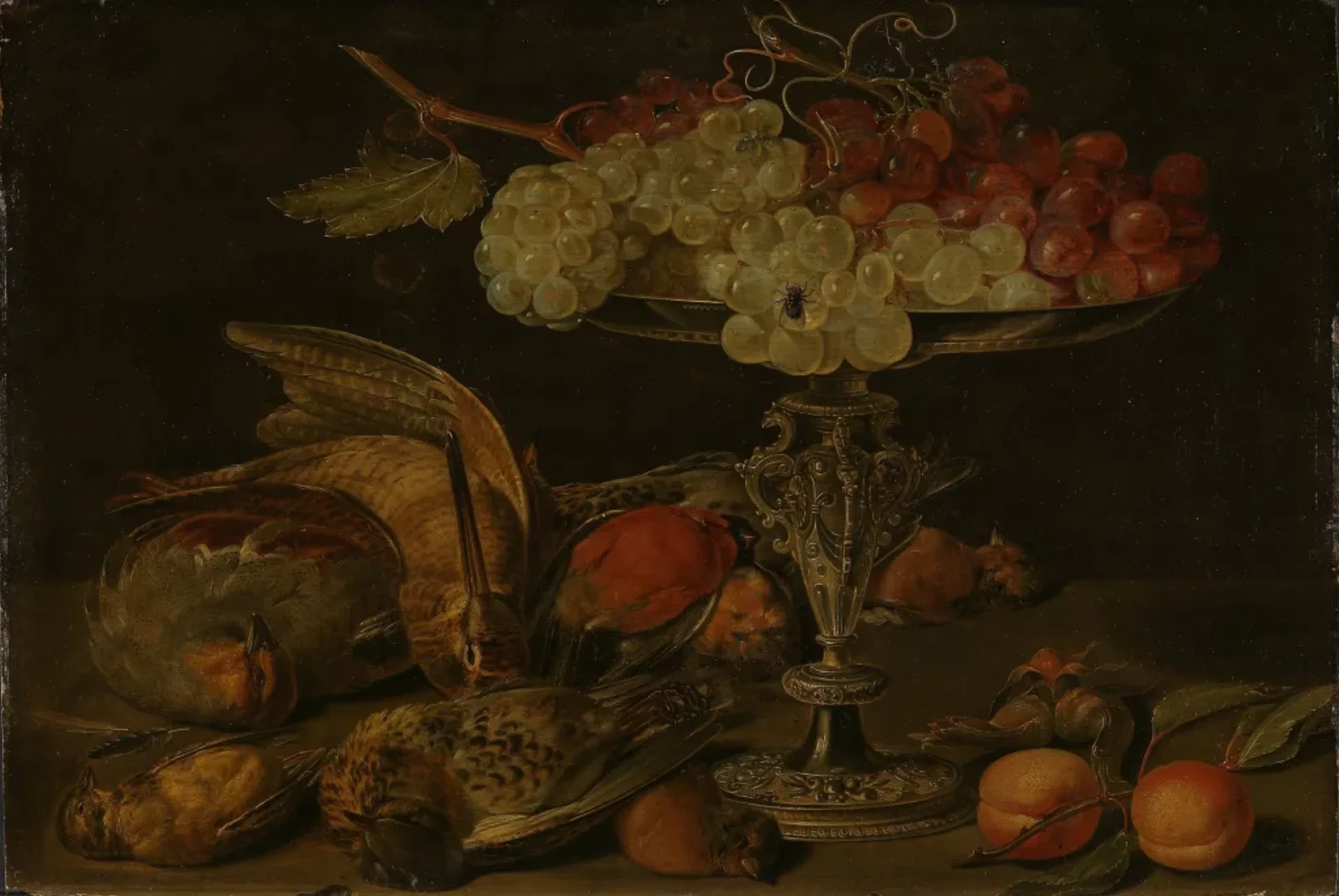
Stylistic analysis remains central to attribution work. Osiecki compared the Oslo painting to other known works by Peeters and found recurring motifs: the tazza, a saucer-like dish on a pedestal, appeared in other Peeters paintings. The positioning of dead game birds, the arrangement of fruit, and the treatment of light on metallic surfaces all showed consistent patterns with Peeters' authenticated body of work. This kind of comparison requires deep familiarity with an artist's complete output, which is why specialist knowledge is essential. Generalist art historians may not recognize the significance of a particular type of tazza or the specific way an artist renders the texture of a grape.
The field of Peeters scholarship is small enough that a single attentive curator can make a discovery that has eluded others for a century. This is both a strength and a vulnerability: the recovery of women's art history depends on individual scholars with specific expertise, and when those scholars retire or move on, the knowledge may be lost. Institutional support for this kind of specialized research is essential if the project of recovery is to continue.
Step Three: The Signature Problem
One of the challenges in attributing works to female artists is that signatures are often missing, damaged, or were deliberately removed. Clara Peeters was known for signing her works, but the Oslo painting had no signature. The panel had been damaged by woodworm, and the area eaten away was the bottom edge, precisely where Peeters typically placed her signature. This kind of damage can erase the most crucial piece of evidence for authorship. The problem is compounded for women artists who were less likely to sign their works in the first place, either because they were excluded from the professional structures that made signatures meaningful or because later owners deliberately removed signatures to obscure authorship.
Peeters was also known for embedding miniature self-portraits in her paintings, often as reflections in pewter or glass objects, or on the shiny surfaces of fruit. Osiecki detected shapes on the grapes in the Oslo painting that resembled outlines of human figures, possibly the remnants of one of these embedded self-portraits, degraded during past conservation work. The loss of such details during cleaning and restoration is a recurring problem in the study of female Old Masters, whose work has often been subjected to aggressive conservation treatments over the centuries, sometimes precisely because their lower market value made them lower priorities for careful handling.
Step Four: Archival Research
Beyond technical analysis, archival research is essential. Inventories of collections, artists' ledgers, guild records, and correspondence can all provide evidence that a particular painting was created by a particular artist. The problem is that women were often excluded from guilds, and their work was less likely to be documented in official records. When a painting by a woman was sold, it was sometimes catalogued under a male artist's name to increase its market value, a practice that persisted into the twentieth century.
The Getty Research Institute and similar institutions have been digitizing archival materials that make this kind of research more accessible. The growing availability of digital databases of inventories, provenance records, and exhibition histories is accelerating the pace of reattribution. Cross-referencing collection inventories with artists' biographies, guild registers, and sales records can establish documentary chains of evidence that support technical and stylistic analysis. As Osiecki noted, the more archival research scholars do, the more women they will find.
The Institutional Will to Look
Technical and archival methods are necessary but not sufficient. The rediscovery of female Old Masters requires institutional will: museums must be willing to invest staff time in reviewing their storage areas, and curators must be given the resources to pursue attributions that may not yield immediate blockbuster results. The National Museum of Norway's decision to mount Woman Painter, a major exhibition opening October 8, 2026, featuring nineteen female artists from the period 1550 to 1650, signals that the institution is committed to this project. Other museums have taken similar steps. The Prado's 2016 Peeters solo was a landmark. The National Gallery in London acquired its first painting by Artemisia Gentileschi in 2018. The Uffizi has been reattributing works by women in its collection. These institutions are not just recovering individual paintings; they are revising the narrative of European art history to include the women who were always there but were systematically written out.
What Comes Next
The reattribution of the Oslo Peeters is a single data point in a much larger project. As Osiecki told ARTnews, there will be many more finds in the future. The storage areas of European museums are full of paintings labeled "anonymous" or attributed to minor male artists, and the methods for identifying their true authors are becoming more sophisticated and more widely available. The rediscovery of female Old Masters is not a passing trend but a structural shift in how art history is written, one that will continue to reshape the canon for decades to come. For museums, collectors, and scholars, the implication is clear: look again at what you have in storage. The next Peeters may already be in your collection, waiting for someone with the knowledge and persistence to see it.
The practical implications for museums are significant. Reattribution can change the insurance value, display priority, and conservation budget for a work. A painting labeled "anonymous" in storage has little institutional leverage; the same painting attributed to a named artist, particularly one as significant as Clara Peeters, becomes a centerpiece. This dynamic creates an incentive for museums to invest in attribution research, but it also raises questions about whether the motivation is scholarly or commercial. The best reattribution projects, like the one at the National Museum of Norway, are driven by curatorial expertise rather than market calculations, but the two are not always easy to separate. For collectors, the lesson is to pay attention to what is in storage. The next major discovery may not come from an excavation but from a careful reexamination of what institutions already own. The tools are available, the methodologies are proven, and the institutional will is growing. What remains is the sustained investment in curatorial expertise and the patience to look carefully at what has been overlooked for far too long. The storage areas of European museums are full of anonymous paintings waiting for their authors to be found. The question is whether institutions will commit the resources to find them. The evidence from Oslo suggests that when they do, the results can be transformative. The methodology is proven, the tools are available, and the institutional will is growing. The next Peeters is waiting in storage right now.