How to Navigate London Gallery Weekend 2026
A sharp route through London Gallery Weekend 2026, with the shows, neighborhoods, and viewing strategies that matter most if you only have one weekend
Start With a Strategy, Not a Checklist
London Gallery Weekend has grown large enough that trying to see everything is the fastest route to seeing nothing well. This year’s edition brings together more than 120 galleries and over 80 public events, according to The Art Newspaper’s survey of critics’ picks. That scale is the point of the weekend, but it is also the trap. The strongest way to approach the city over these few days is to build a route around contrasts: one stop that clarifies where commercial painting is heading, one that tests how galleries handle installation or performance, one that tells you something about London’s new geography beyond Mayfair, and one that reveals whether a much-hyped exhibition can actually hold attention in a crowded room.
The official London Gallery Weekend platform is useful for logistics, while the interactive map is the practical tool you should actually keep open on your phone. But neither will edit the weekend for you. That is the real job. A good plan should assume you will not cross the city endlessly, will not spend equal time on every room, and will not remember much from your twelfth white cube unless you deliberately vary the texture of the day. If you want a broader frame for reading art in a city saturated by collateral programming, our earlier London marquee-week report is a useful companion because it tracks the commercial pressures humming behind the cultural abundance.
Build Day One Around West End Precision and Two Strong Painters
If you have one full day, start in the West End, where density still favors disciplined looking. The critic picks highlighted by The Art Newspaper make clear that this year’s strongest route is less about trophy names than about concentration. One of the best anchors is Jiab Prachakul at Pilar Corrias, where painting becomes a carrier of family archive, migration, and grief without turning illustrative. Prachakul’s source material includes personal and archival images, but the work matters because it never treats paint as a mere delivery system for memory. You should give this show time. The surfaces and erasures do more than summarize biography; they make emotional ambiguity visible.
From there, move toward another painting-led stop that changes the register rather than repeating it. The weekend’s overview also points to the continued vitality of galleries such as Sadie Coles HQ, Modern Art, and Thomas Dane, where strong solo exhibitions are placed inside neighborhoods that remain central to London’s dealer ecology. If you choose Thomas Dane, the attraction is not just Caragh Thuring’s show but the chance to see how the gallery balances visual wit with painterly seriousness. The point of pairing these exhibitions is to compare how two very different painters metabolize history, image, and atmosphere. Looking in sequence is more revealing than treating each stop as an isolated event.
Keep the first day relatively compact. London punishes overambitious itineraries because travel time quietly eats your attention. Two or three strong shows, a lunch break, and one late-afternoon event will teach you more than six rushed walkthroughs. The city’s commercial districts remain seductive partly because they create the illusion that quantity equals sophistication. It does not. Sophistication during gallery weekend means knowing when to stop.
Use Day Two to See the London That Is Still Rewriting the Gallery Map
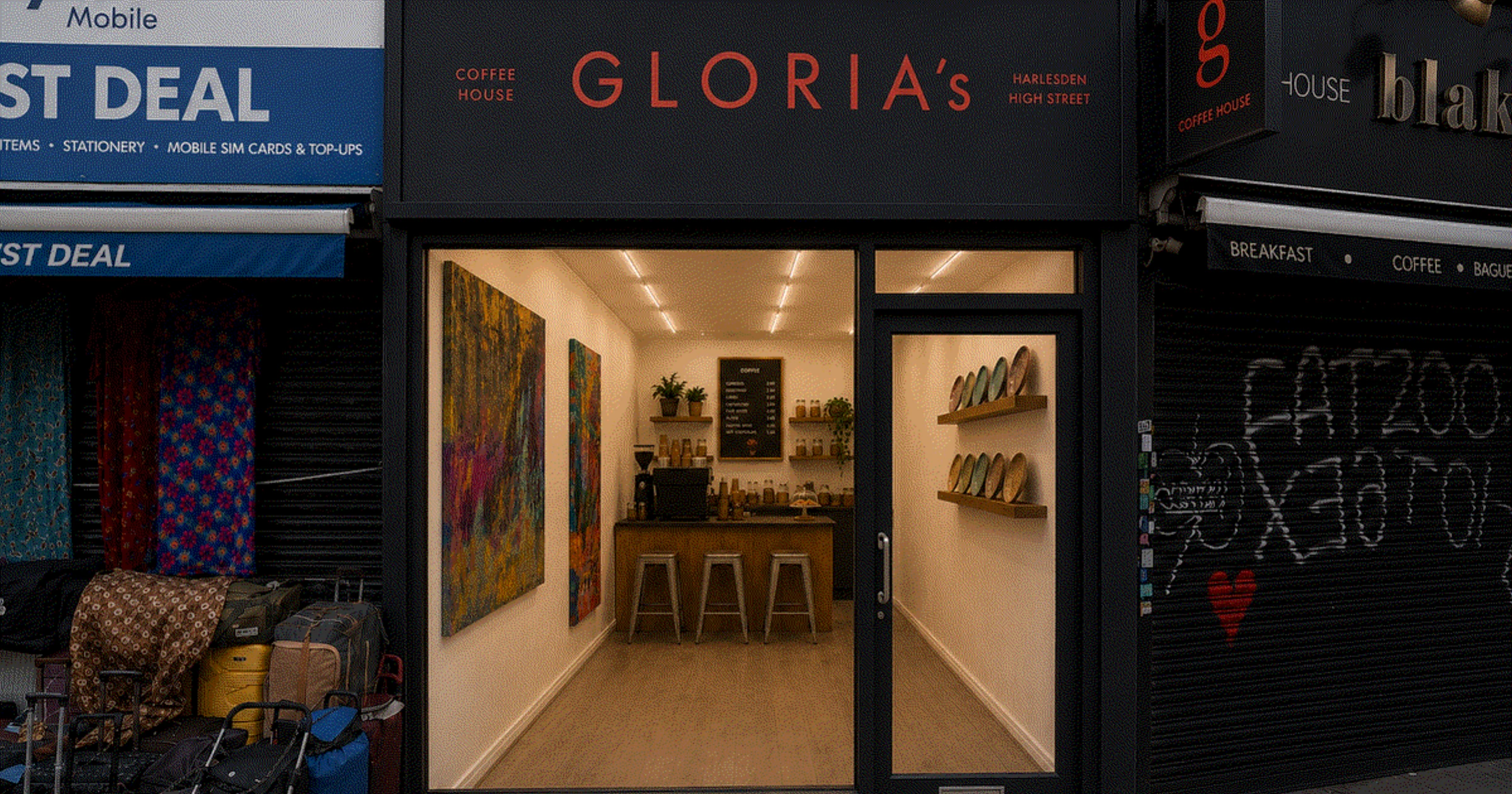
The most interesting curatorial energy this year may be outside the expected centers. The Art Newspaper’s picks emphasize that London’s scene is not simply surviving a market slowdown but redistributing itself through expansions, younger spaces, and more mixed neighborhood identities. That makes Harlesden High Street one of the weekend’s essential visits, not because it offers the smoothest gallery experience but because it deliberately scrambles what an exhibition setting can be. The official event page for Savannah Harris’s Gloria’s project tells you the basic logistics. What it cannot convey in advance is the degree to which the work uses the language of a café takeover to ask who urban cultural space is actually for.
This matters because London Gallery Weekend often markets itself as open, free, and citywide, yet the social codes of commercial galleries can still make new audiences feel peripheral. A project like Gloria’s addresses that unease head-on by folding art into a setting that looks more socially legible than the standard front desk and checklist routine. You should not romanticize the gesture; galleries remain market actors even when they wear the styling of neighborhood hospitality. But the project is smart enough to turn that tension into content. It is one of the few weekend stops where the question of audience is not an afterthought.
If you stay in east or north London for the afternoon, prioritize one exhibition that expands the emotional and political register. The critics’ selections include artists such as Candace Hill-Montgomery, Delaine Le Bas, and Rachel Maclean, each of whom brings a very different way of handling history, technology, and social pressure. The right choice depends on your tolerance for crowded rooms and your appetite for installation versus painting. What matters is that you do not let geography do all the thinking. The newer London map is not interesting merely because it is wider. It is interesting because different parts of the city now support genuinely different exhibition behaviors.
Choose Shows That Reward Slow Looking, Not Just Brand Recognition
Every gallery weekend creates a temptation to drift toward names you already know. Sometimes that works. Anne Imhof at Sprüth Magers will draw visitors for obvious reasons, and there is nothing wrong with testing whether a high-recognition artist can still produce friction inside a commercial booth-like environment. But the weekend is better used to identify where serious looking is still possible under market pressure. Candace Hill-Montgomery’s multi-decade presentation, for example, offers an argument for returning to artists whose reputations are being revised in real time. That kind of show gives you more than novelty. It gives you a timeline and a body of work that can push back against the speed of event culture.
The same logic applies to painters like Tewelde or to materially exacting sculptural practices such as Gabriele Beveridge’s. If a show seems modest at first glance, stay another ten minutes. London dealers have become very good at staging immediately legible impressions for compressed attention spans. The exhibitions that last in memory usually resist that economy. They unfold by temperature, rhythm, or repeated detail. When you feel the urge to move on simply because the room is quiet, treat that as a reason to remain.
This is also where note-taking helps. Gallery weekends produce visual saturation, and your memory will flatten everything into a handful of names unless you record what each exhibition actually did: a color relation, a structural motif, a line from the wall text you distrusted, a material surprise, an installation choice that sharpened or deadened the work. That discipline matters if you are visiting as a collector, curator, writer, or artist. It keeps the city from becoming one long branded blur.
Plan the Social Side Without Letting It Ruin the Art
Public events are one reason London Gallery Weekend keeps widening its audience, but they can also derail a careful plan. Receptions, extended openings, panel conversations, RSVP-only gatherings, and chance encounters all create the pleasant fiction that the weekend is best experienced socially. Sometimes it is. More often, the social layer cannibalizes the looking. Use events selectively. The official listings on the festival site can help you identify a late slot worth attending after you have already seen the day’s core exhibitions. Do not reverse the order.
If you are collecting or advising, the social pressure is even stronger because dinners and previews are where market chatter gets amplified into pseudo-consensus. Resist the urge to let that chatter decide your route. The city is full of people who will tell you what is sold out, who is moving galleries, and which opening has become a scene. None of that reliably predicts where the weekend’s best art is. In fact, some of the strongest shows become legible only once you step outside the crowd’s feedback loop and spend time with work that is not trying to win the room in thirty seconds.
A useful rule is to separate at least one solitary block of looking from one social block every day. See work alone or with one trusted companion in the morning. Save the denser event for later. That rhythm preserves judgment. It also makes conversation better, because you are responding to actual experience rather than rehearsing what everyone else has already decided to repeat.
What a Good London Gallery Weekend Actually Looks Like
A successful weekend is not one in which you maximize attendance. It is one in which you come away with a few sharpened convictions: a painter you want to follow more closely, a gallery whose program feels more coherent than last year, a neighborhood that now matters differently, and a clearer sense of where London’s commercial scene still permits intellectual risk. This year’s edition seems especially strong on that last point. Even under market strain, the city retains an ability to let serious exhibitions coexist with networking theater, speculative chatter, and ambitious younger spaces trying to redefine what the gallery model can feel like.
That is why the best route through London Gallery Weekend 2026 is neither maximalist nor dutiful. It is edited. Start with a few exhibitions that anchor the day, travel less than you think you should, stay longer than you first intend, and use the official map as infrastructure rather than ideology. If you do that, the weekend stops being a scavenger hunt and becomes what it ought to be: a compact lesson in how a city’s art ecosystem reveals itself when it is under pressure to perform.
And if you miss half the list, good. The point is not completion. The point is discrimination. London offers abundance every day of the year. During gallery weekend, the real skill is deciding what deserves your attention before the city spends it for you.